Select a site alphabetically from the choices shown in the box below. Alternatively, browse sculptural examples using the Forward/Back buttons.
Chapters for this volume, along with copies of original in-text images, are available here.


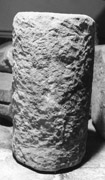
Object type: Part of round column [1]
Measurements: H. 45 cm (17.7 in); W. 29 > 26 cm (11.4 > 10.2 in); D. 27 cm (10.6 in) at base
Stone type: Medium-grained, moderate reddish orange (10R 5/6), feldspathic sandstone with haematite specks. Namurian sandstone consistent with Roaches or Ashover Grit, Marsden Formation, Millstone Grit Group, Carboniferous (R.T.)
Plate numbers in printed volume: Ills. 627–8
Corpus volume reference: Vol 13 p. 316
(There may be more views or larger images available for this item. Click on the thumbnail image to view.)
Slightly ovoid with vertical tooling marks, and distinctly tapered; the broken area at one end may represent an attempt at carving which was subsequently abandoned.
Appendix A item (stones dating from Saxo-Norman overlap period or of uncertain date)
The damaged and incomplete nature of the stone means it is not possible to make many observations. It is possible that, along with Alstonefield 14-16, these fragments of pillars were originally from Roman milestones stationed along the Roman road located approximately 5 km to the east of Alstonefield (compare Fig. 35, p. 86). There is every possibility that they were brought to the site to be re-carved as round-shafted crosses (as seems to have been the case with Alstonefield 6, pp. 268-9). The slightly ovoid cross-section strongly suggests this attempt at re-carving.
