Select a site alphabetically from the choices shown in the box below. Alternatively, browse sculptural examples using the Forward/Back buttons.
Chapters for this volume, along with copies of original in-text images, are available here.


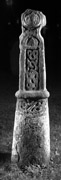
Object type: Round-shaft with remains of cross-head
Measurements: H. 139 cm (54.7 in); W. 33 > 20 cm (12.9 > 7.9 in); D. 31 > 12 cm (20.2 > 4.7 in)
Stone type: Graded, light reddish brown (5YR 6/4), clast-supported, poorly sorted, feldspathic sandstone; the subangular to subrounded grains vary from 0.1–1.0 mm across. No large rounded quartz pebbles seen (as in Ilam 1). Namurian sandstone consistent with Ashover Grit Member, Marsden Formation, Millstone Grit Group, Carboniferous (R.T. & C.R.B.).
Plate numbers in printed volume: Ills. 551–2, 554–5
Corpus volume reference: Vol 13 p. 290-291
(There may be more views or larger images available for this item. Click on the thumbnail image to view.)
This piece is a round-shaft, type h (Cramp 1991, fig. 1) with the boss, arm-pit and stub of a cross-arm visible at the top. It has a broad collar moulding approximately half way up the stone which appears to be a roll moulding. Above the collar, the upper section has a rectangular cross-section.
The lower cylindrical section is decorated just below the collar with what appears to be a continuous asymmetrical scroll pattern on all faces, with a triple leaf pattern below on D, the rest of the shaft being plain.
A (broad): The upper rectangular section is decorated with a panel containing an asymmetrical three-strand simple interlace contained on each side by a broad edge moulding which, although weathered, appear to be roll mouldings. Above the panel of decoration is a low-relief moulding, separating the panel from the cross-head above. The lower cross-arm has an inverted U-shaped strand which may have been part of a two-strand interlace, now worn away at the top. The boss at the centre of the cross-head is visible and appears to have been surrounded by a circular moulding. On the right is the stub of the horizontal cross-arm, now broken off; the upper cross-arm is also missing.
B (narrow): Decorated with a panel containing a badly eroded three-strand interlace which, like that on A, appears to be asymmetrical. There are broad rolled edge mouldings on each side. Above the panel the stone is badly worn and any band or moulding has been lost. The weathered remains of the lower cross-arm of the cross-head extend from the top of the stone where there is the broken end of the horizontal cross-arm.
C (broad): Although worn, this face appears to be decorated with a panel containing a three-strand, simple interlace, bound on either side by broad edge mouldings, with that on the right having stipples which may be the remains of surface decoration, although the effect of differential weathering cannot be discounted. Above the panel of interlace is a low-relief moulding, above which is the lower arm of the cross-head that may have contained an interlace pattern but this is now unclear. There is a boss above this cross-arm which doubtless was the centre of the cross-head. Although broken on its surface, this is surrounded by a circular moulding. To the left is the stub of a horizontal cross-arm, with most of its lower arm-pit clearly visible.
D (narrow): This face is decorated with a panel containing a line or key pattern which terminates at the bottom in a simple spiral. The edge moulding on the right appears to have some form of slight banding but, as with C, this may be due to differential weathering. Above the panel of decoration is the junction with the cross-head which has been badly weathered and any decoration is now lost. The broken face of the stub of the cross-arm tops this face, with the arm-pit of the horizontal arm clearly visible.
This piece is one of a series of round-shafted crosses in the region. Similar examples can be found at Alstonefield (6), Chebsey (1), Bakewell (25), Brailsford (1) and elsewhere, including several examples in Cheshire–like that at Adlington (Bailey 2010, 45–6, no. 2, ills. 2-8). The lower parts of these round-shafted crosses are, like this example, ovoid in section and, in this region, tend to be plain, although this example and those at Brailsford, Heaton and Leek (6) have decoration on the upper part, just below the collar separating them from the upper rectangular sections. As elsewhere, it is possible that this shaft was recut from an existing stone column.
