Select a site alphabetically from the choices shown in the box below. Alternatively, browse sculptural examples using the Forward/Back buttons.
Chapters for this volume, along with copies of original in-text images, are available here.


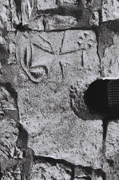
Object type: Grave-marker
Measurements: L. c. 160 cm (42 in); W. c. 76 cm (30 in); D. Built in
Stone type: [Inaccessible; but similar in appearance to the dolomitic limestone used for Carlton-in-Lindrick 1]
Plate numbers in printed volume: Ills. 5-6
Corpus volume reference: Vol 12 p. 95-6
(There may be more views or larger images available for this item. Click on the thumbnail image to view.)
The decoration of this item has been noted previously, but taken to be an eccentric elaboration of the simple Romanesque window-head rather than evidence of a reused earlier monument (Keyser 1907, 140; Walkerdine and Buxton 1907, 41; Cox 1912a, 226–7; Hill 1914; Mee 1938, 302).
The west tower at Church Warsop is of 'early Norman' form. The tower is unequivocally dated from the form of the tower arch and of the west door, and this implies a date in the late eleventh or early twelfth century for its construction (e.g. Pevsner and Williamson 1979, 364; see Chapter VI above). The grave-marker is clearly reused in this structure and thus its original manufacture can be dated to at least a generation before the tower's construction, very likely from the first half of the eleventh century.
This is a complete rectangular marker of a type familiar in the East Midlands, comprising a substantial rectangular slab about twice as tall as it was wide, though of a thickness that varied with the petrology employed in each case. Typically, the lower two-thirds of the stone's surface was left roughly hewn as this part was buried when the stone stood in its intended position. At Church Warsop the boundary between the smoothly finished and sculpted upper third and the roughly tooled lower part is still quite evident. This uppermost third is decorated with a large, equal-armed cross of Corpus type E6 (Cramp 1991, xvi, fig. 2) in low-relief. The left-hand side of the upper arm of the cross swells asymmetrically and was probably originally connected to a swirl of foliage(?) or a curving fillet, that extends down this side of the cross to terminate in a loop in the lower interstice on this side. There is additional decoration between this fillet and the border of the stone, though its precise form cannot be made out from the ground. In the upper right of the original stone, and apparently unconnected with the cross, is an incised six-petal 'flower' of the type frequently seen as a mason's doodle or training exercise with a pair of compasses.
When set alongside Carlton-in-Lindrick 1 (Ill. 4), Church Warsop 1 adds to the evidence for a quarry workshop utilizing Pennine limestone to produce rectangular grave-markers in the East Midlands tradition in the eleventh century. It is especially useful for understanding this phenomenon that this piece was reused in a building that can be quite precisely dated to the early twelfth century. We can therefore be confident that this monument, at least, was probably produced before the Conquest. Gravemarkers bearing this form of cross-head occur in a number of other petrologies: for example at Beelsby 1, Cabourne 1, Hawerby 1 and 2 (all Lincolnshire and all cut in Cretaceous 'Tealby' limestone) and Lincoln St Mark 20 and Saxilby 2 (both in Jurassic Lincoln limestone) (Everson and Stocker 1999, 275, 277–8, 279, 282–3, 289–90). Amongst these examples, however, none takes the form of a rectangular slab, as seen at Church Warsop; they are mostly of a much narrower, tapered form. This feature also suggests that Church Warsop 1 (perhaps along with Carlton-in- Lindrick 1) comes relatively early in the sequence of East Midlands grave-markers, in a tradition which we have proposed began with the 'Lindsey markers' in the late tenth century (Everson and Stocker 1999, 60–1). The Pennine limestone production centre deserves to be considered alongside the eleventh-century quarry centres at 'Ancaster' and 'Barnack', which we argued were producing this type of marker in the eleventh century in imitation of the original Lindsey markers (ibid.). The compass-drawn motif in the top right-hand corner of the stone is probably an addition to the original monument, presumably added at the time of its reuse.
