Select a site alphabetically from the choices shown in the box below. Alternatively, browse sculptural examples using the Forward/Back buttons.
Chapters for this volume, along with copies of original in-text images, are available here.


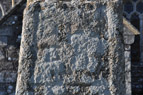
Object type: Cross-shaft and -head
Measurements: H. 80 cm (31.5 in) (head), 179 cm (70.5 in) (shaft, to ground); W. 89 cm (35 in) (head), 63 > 46 cm (24.8 > 18.4 in) (shaft); D. 25 cm (9.8 in) (head), 41 > 26 cm (16.3 > 10.3 in) (shaft)
Stone type: Coarse-grained granite with feldspar mega-crysts up to 1.5 by 0.6 cm set in an equidimensional mix of white feldspar and quartz crystals. There is some tourmaline intergrowth, together with fragments of white mica up to 3 mm across. Bodmin Moor Granite
Plate numbers in printed volume: Ills. 42-6, 352, 361; Colour Pl. 1; Figs. 17e, 18a
Corpus volume reference: Vol 11 p. 131-2
(There may be more views or larger images available for this item. Click on the thumbnail image to view.)
Complete cross with rectangular shaft. The cross-head is of type E8, with widely splayed cross-arms and a slightly recessed ring, type b. The openings are triangular and each has a shallow projecting band on the inside of the ring. A small section at the top of the tapering shaft has been lost or cut off. A narrow roll-moulding encloses the decoration on the head and runs around the edge of the ring. On the shaft is a wider roll-moulding, within which all the carved decoration is deeply cut; however the inscription is less clear.
A (broad): Linked single-strand triquetras or Stafford knots (simple pattern E) fill the cross-arms. In the centre of the cross-head is a small flat boss with a shallow hole in the centre. The decoration on the shaft is in three panels, without any moulding or line between them. The top panel contains the inscription, incised in three horizontal lines. The text is probably incomplete at the beginning where part of the shaft is lost. The letters are 4 to 8 cm in height, are rather deteriorated and are predominantly insular in form. The text reads:

The middle panel contains an unusual and worn knot, apparently consisting of two rings with a central horizontal bar separating two interlacing 'V'-shaped rings. Below this is a panel of poorly laid-out six-strand plait, separated by a glide from a further knot, now hidden below ground level.
B (narrow): According to Langdon there is a single Carrick Bend (simple pattern F knot) on the cross-arm (Langdon, Arthur 1896, 356), but this is not now clear. On the ring is a central raised band. On the shaft is a simple plait which metamorphoses, about one third of the way down, into a simple ring-twist (closed circuit pattern A), the knots separated by glides.
C (broad): Double-strand linked triquetras (simple pattern E) fill the cross-arms. At the centre of the cross-head is a small flat boss with a shallow hole in the middle. On the shaft is a spiral scroll with ridged nodes and a small bud in each of the spandrels. The pattern is incomplete at the top where part of the shaft is lost.
D (narrow): On the end of the cross-arm is a pattern which may be either a simple two-strand plait or a rectangular fret, J4 (Fig. 19b, p. 72). The top third of the shaft is filled by a rectangular fret, K1 (Fig. 19a) and below this, a vertebral ring-chain (type Cvii).
The text on face A probably reads: [A]R[A]H+ (Ill. 42), and is likely to have been a personal name of unknown origin.
The use of the Manx type of ring-chain implies a date from the tenth century (Bailey 1980, 72, 217). The use of ring-knots and simple frets are also typical work of this period. The tight spiral scroll, which in strong contrast with St Neot 3 (Ills. 155–8) is entirely stripped of leaves and rendered as an unnaturalistic pattern, bears some resemblance to the scrollwork of the Cumbrian 'spiral-scroll school', which is of Viking-period date (Bailey and Cramp 1988, 36).
The presence of ring-chain indicates a place which, despite its relative seclusion on the edge of Bodmin Moor, was open to influence from artistic ideas current around the Irish Sea in the tenth century. Within Cornwall the cross was locally influential. Most notably, the spiral scroll (although not in such a tight form) is seen on various other monuments in the area, for example Lanhydrock 1, Lanivet 1 and War-leggan 1 (Ills. 110, 114, 239).
The cross can thus be reasonably securely dated. The problem is to establish what such a prestigious monument is doing at Cardinham, where there is no record of a religious community. An early Christian memorial stone provides evidence of the early origin of the site (Okasha 1993, 88–90, no. 9; Thomas, A. C. 1994, 265, 307, 328, no. 458); this has been dated to the sixth century by Thomas. Other stones in the parish from Tawna and Welltown (Okasha 1993, 288–90, 322–5; Thomas, A. C. 1994, 265, 307, 328) are further evidence of Christian activity in the area. The early name of Cardinham church-site is not known: Cardinham is the name of the castle which was the centre of a major fiefdom established here by Richard Fitz Turold, one of the chief landowners of Cornwall, after the Norman Conquest (Henderson, C. 1925, 71; Picken 1955). The name of nearby Trezance refers to the 'land of the saint' (Padel 1985, 204, 217), a name unique in Cornwall which could refer to an ecclesiastical site at Trezance (Picken 1955, 204–5), or to land which was formerly part of the endowment of the church, but either way implying the presence of an early land-owning community in the area whose lands had been appropriated before the Norman Conquest. Thus the cross could be associated either with an early religious community at Cardinham church-site or alternatively, and perhaps more likely, with a secular patron who was a predecessor of the powerful Norman earls of Cardinham. Unfortunately the inscription is too worn to give a clue, though it is likely to be a personal name and possibly that of the patron.
