Select a site alphabetically from the choices shown in the box below. Alternatively, browse sculptural examples using the Forward/Back buttons.
Chapters for this volume, along with copies of original in-text images, are available here.


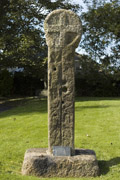
Object type: Cross-shaft and -head
Measurements: H. 189 cm (74.4 in); W. 49 cm (19.3 in) (head), 34 cm (13.5 in) (shaft); D. 28 cm (11 in)
Stone type: Carnmenellis Granite (A.V.B.)
Plate numbers in printed volume: Ills. 291-3
Corpus volume reference: Vol 11 p. 234-5
(There may be more views or larger images available for this item. Click on the thumbnail image to view.)
A large fragment has broken off the bottom of the shaft, but otherwise the cross is complete. It is a round-headed cross with a shaft of rectangular section and slight remains of a projecting roll-moulding at the junction of head and shaft. The decoration on the shaft consists of a range of incised zig-zags, crosses and horseshoes.
A (broad): Within an incised edge-moulding is a straight-armed cross (type A1), formed by sinking four triangular areas; the right cross-arm is very slightly expanded at the end. At the centre of the cross is a small hollow. An incised edge-moulding runs part way down the shaft, and the whole of this face is divided into two vertical panels by a broad groove down the centre. Within the right panel is a series of incised triangles or zig-zags and below this three incised horseshoe-shaped motifs. The left panel is less clear as a result of the damage it has sustained. Peter (quoted in Thomas, A. C. 1967a, 90; see also Peter 1898, 76–7) recorded an incised figure standing on a shield and below the shield two interlaced circles and more interlace pattern; however this is all extremely uncertain. Borlase's sketch (reproduced by Thomas, A. C. 1967a, fig. 19) suggests zig-zags and horseshoes, mirroring the arrangement on the right side of the shaft. However the upper half is now defaced so that all that is visible are one or possibly two horseshoe-shaped motifs and, at the bottom, the remains of incised zig-zags or diagonal crosses.
B (narrow): There are possible remains of a roll-moulding projecting at the junction of head and shaft. This side is very abraded and there are now no clear traces of any decoration.
C (broad): The cross on the head is as on face A although the incised edge-moulding is now only clear on the left side. The shaft is very worn and the only ornamentation which can be made out are traces of an incised edge-moulding and two incised lines on the lower part.
D (narrow): At the junction of head and shaft is a projecting roll-moulding but no other decoration is visible.
Appendix D item (continuing tradition)
This cross is one of a small group in the Carnmenellis granite area bearing a simple geometric cross on the round (wheel) head and characterised by chevrons or zig-zags and other incised patterns on the shaft (p. 107). The crosses in this group do duty as boundary stones and wayside crosses or mark chapel sites but none are associated with parish churches.
Both this cross and the cross from Nine Maidens Down (Wendron 5, Ills. 334–6) bear a strong resemblance to that now at Scorrier but originally from Rame in Wendron parish (Wendron 6, Ills. 337, 346–9). However, both Camborne 4 and Wendron 5 have much more crudely carved decoration than Wendron 6 and are therefore likely to be close derivatives.
Although Thomas suggests a pre-Norman date for all of these crosses (Thomas, A. C. 1967a, 90), they are more likely to be post-Norman Conquest. The zig-zags suggest Romanesque work. The straight-armed cross on the head is similar to the Early Geometric crosses seen on medieval grave-covers elsewhere (for example Calverley 2, Adel 2, Emley 1 in Yorkshire: Ryder 1991, 8, 17, 22–3). The horseshoe-like motifs on the shaft are likewise reminiscent of the emblems incised on medieval grave-slabs, for example at Rothwell also in Yorkshire (Ryder 1991, 40). Horseshoes would normally be taken to denote the grave of a blacksmith: here it is uncertain what their meaning is, although Langdon suggests a possible connection with the Ferrers family of Trelowarren, whose heraldic emblem included horsehoes (Langdon, Arthur 1896, 332n).
An altar stone in Camborne church (Camborne 1, p. 129, Ills. 36–8) may originally have come from the same well-chapel site as the cross.
