Select a site alphabetically from the choices shown in the box below. Alternatively, browse sculptural examples using the Forward/Back buttons.
Chapters for this volume, along with copies of original in-text images, are available here.


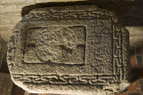
Object type: Part of an altar
Measurements: L. 98.5 cm (38.8 in); W. 71.5 cm (28.3 in); D. 22.5 > 21 cm (8.9 > 8.3 in)
Stone type: Coarse-grained granite with feldspar forming about 40% of the rock; scattered small megacrysts up to 1.5 cm occur. Equidimensional quartz crystals range up to 10 mm; there are some scattered flakes of white mica. Carnmenellis Granite
Plate numbers in printed volume: Ills. 39-41, 356-7
Corpus volume reference: Vol 11 p. 130-1
(There may be more views or larger images available for this item. Click on the thumbnail image to view.)
Rectangular slab with decoration and inscription on one surface only. One long side is slightly recessed from the top, below which the edge is chamfered. All other sides are flat, with a rounded lower edge. The underside is roughly dressed, and at the centre, mostly hidden by the stone on which it is set (Camborne 3, p. 212), there is a recess of uncertain size. The decorated surface has a relief-carved T-pattern, meander type 1 (the Welsh K1 – see Fig. 19a, p. 72), forming a wide border. The pattern is neatly executed but the corners are not well turned. Within this border is a linear incised cross, type A1, within an incised rectangular frame. This is set off-centre and in the space between the border and the cross frame is an inscription. The text is rather deteriorated but seems to be complete and to use insular script. The final letter is set below the rest. The text reads:

The inscribed text reads ÆGU[.]ED, with the possibility of another letter between the first two, although an alternative reading of the G might be EL (Ill. 41). Langdon and Allen suggested a reading of ÆGVRED and the lost letter towards the end of the text might indeed be an R, although the preceding letter is certainly U not V (Langdon, Arthur and Allen, J. R. 1895, 51, 58, 60 and fig.). The text is likely to be a personal name, and probably of English origin: -red is a common second name-element of Old English male names. The first element æ[.]gu- or æ[.]elu- might be a spelling of one of the common first name-elements æthel- or ælf-, both of which are recorded with a number of alternative spellings (Feilitzen 1937, 172, 182).
This slab is considered by most authorities to be an altar mensa and this seems most likely although there are no consecration crosses. As it is set at present (as an altar slab, with the long edge against the east wall of the church, as seems logical) the text is sideways on and the incised cross asymmetrical. One would expect a more symmetrical arrangement with the cross at the centre. Perhaps, therefore, it was originally an altar frontal with the text at the bottom, like Camborne 1 (Ills. 36–8), although as Thomas points out, it would then be rather tall (Thomas, A. C. 1967a, 108). If its function has indeed changed, the present chamfered edge may not be original. The scale and the function of the recess on the underside of the stone are uncertain, but the recess may perhaps have been created to hold relics.
This slab was considered by Henderson to be by the same craftsman as Camborne 1 (Henderson, C. 1935, 84). However Thomas, on the basis of the inscription, the execution of the key pattern and the chamfer, suggests that it is a slightly later piece of work (Thomas, A. C. 1967a, 104–6). The T-pattern is an example of the type of straight-line pattern commonly found in Viking-age contexts elsewhere in Britain.
The stone is most likely to have come from the ruins of the chapel of St James at Treslothan in Camborne parish, said by Thomas to have been a manorial chapel of the late pre-Conquest era (Thomas, A. C. 1967a, 64–7). If so, this stone would be important evidence for the pre-Norman origin of this chapel which otherwise is not recorded until 1427 (Thomas, A. C. 1967a, 64).
[1] It is not certain that this reference is to Camborne 2.
[2] It is not certain that this reference is to Camborne 2.
