Select a site alphabetically from the choices shown in the box below. Alternatively, browse sculptural examples using the Forward/Back buttons.
Chapters for this volume, along with copies of original in-text images, are available here.


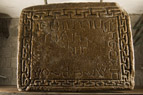
Object type: Part of an altar
Measurements: L. 108 cm (42.5 in); W. 84.5 cm (33.3 in); D. 18 > 16.5 cm (7 > 6.5 in)
Stone type: Tuckingmill elvan (A.V.B.)
Plate numbers in printed volume: Ills. 36-8
Corpus volume reference: Vol 11 p. 128-9
(There may be more views or larger images available for this item. Click on the thumbnail image to view.)
Rectangular slab with decoration and inscription on one surface only. Because of the way the slab is now mounted, much of the underside is not visible, but it is clear that it has a roughly dressed flat surface. Five 'plain' crosses are said to be 'cut in the usual positions' on this surface (Sedding, E. 1909, 163–4; see also Adams, A. 1888–92, 206).
The decorated surface has a relief-carved T-pattern, meander type 1 (the Welsh K1 – see Fig. 19a, p. 72), forming a border. This is neatly executed but poorly laid out, so that the width of the border varies, the length of the repeating units (the individual T-s) in the pattern varies, and the corners are irregularly turned. Within this border is an inscription reading:

The text is incised clockwise in five lines with the letters facing inwards. It is in a predominantly insular script and is complete and legible. At the centre of the stone is an incised cross, type A1, but with very slightly expanded arm-ends.
The inscribed text reads: leuiut iusit : hec altare : pro anima + sua, that is, 'Leuiut ordered this altar for his own soul' (Ill. 38). For a discussion of the Latin in this text see Chapter VIII, pp. 82–3, and Okasha 1993, 83. The name leuiut could be Celtic, with the Celtic name element leu-, or English with the Old English element leof-; the name leuiet is recorded in Domesday Book as a spelling of leofgeat (Feilitzen 1937, 311). It is clear from the text that the stone is part of an altar. Thomas argues plausibly for its initial use as an altar frontal, then for its re-use as a mensa with the surface with consecration crosses uppermost, the decorated and inscribed face downwards (Thomas, A. C. 1967a, 106–7).
This slab is considered by Henderson to be by the same craftsman as that at Treslothan, Camborne 2 (Henderson, C. 1935, 84; see Ills. 39–41). Thomas suggests, however, that because the fret and inscription are better executed, it is an earlier piece of work (Thomas, A. C. 1967a, 104–6). It is certainly a remarkable coincidence that two such similar examples of such a rare monument type should occur so close together in one parish, both at non-parochial chapel sites (or allegedly so in this case). Therefore, whether one is a copy of the other or both are by the same craftsman, they are likely to be very close in date.
The T-pattern is an example of the type of straight-line pattern commonly found in Viking-age contexts elsewhere in Britain; the insular script supports such a dating.
As noted above, the stone was first recorded at Camborne church, which Thomas suggests may have originated as the eleventh-century chapel of the vill or tenement of Cambron (Thomas, A. C. 1967a, 137). The tradition that the altar in fact came from a chapel in the parish is not recorded until over a hundred years after its first notice; nevertheless this tradition is accepted by Thomas (Thomas, A. C. 1976a, 101–2). The chapel in question, St Ia's, is dedicated to a Cornish saint and associated with a holy well. Even though the site has been excavated, the altar stone, assuming that it did indeed come from here, would constitute the earliest dating evidence for the site (Thomas, A. C. 1967a, 81). In fact it is a rare piece of material evidence for any pre-Norman chapel building in Cornwall. A cross of probable Norman-period origin, also from the site of St Ia's chapel, is included in Appendix D, Continuing Tradition, as Camborne 4 (Fenton-Ia); see p. 234.
