Select a site alphabetically from the choices shown in the box below. Alternatively, browse sculptural examples using the Forward/Back buttons.
Chapters for this volume, along with copies of original in-text images, are available here.


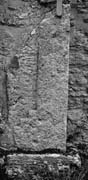
Object type: Stepped pilaster base
Measurements: H. of stone: 121 cm (47.6 in); W. max. 50 cm (19.7 in); D. 24 cm (9.4 in); W. of pilaster: 24 cm (9.4 in); W. of steps in stepped base: 30 cm (11.8 in), 37 cm (14.5 in), 43 cm (16.7 in); D. of carving: 2 < 2.5 cm (0.8 < 1 in)
Stone type: Yellowish grey (5Y 7/2), matrix-supported, poorly sorted, micritic shelly oolite. Ooliths range from 0.2 to 0.6 mm, but most are in the range 0.3 to 0.5 mm. Most ooliths have fallen or weathered out to give an 'aero-chocolate' texture. The ooliths form about 65% of the stone. Scattered bivalves occur up to 2 cm across. The shell debris constitutes about 5% of the stone. Farmington Freestone?, Tayton Limestone Formation?, Great Oolite Group, Jurassic.
Plate numbers in printed volume: Ill. 97
Corpus volume reference: Vol 10 p. 153
(There may be more views or larger images available for this item. Click on the thumbnail image to view.)
Pilaster with stepped base carved onto the lower quoin stone. The south-east pilaster of the nave is carved across the large, roughly shaped long-and-short quoins. The base of the pilaster widens to the west through three steps, to sit on a plain plinth that is continuous around the nave.
The stepped base is seen in manuscript illuminations of the late Anglo-Saxon period, for example as part of the architectural setting for the portrait of St Luke in the mid eleventh-century St Margaret's Gospel Lectionary (Oxford, Bodleian Lib. MS Lat. lit. F. 5: Temple 1976, 106–7, cat. 91, ill. 279). A painted stone panel from St Mary's, Deerhurst, dating from the second half of the tenth century, depicts a standing figure within a painted architectural frame which consists of a triangular arch supported by piers with stepped bases and matching stepped capitals (Bagshaw et al. 2006, fig. 2; see Deerhurst St Mary 7, p. 173).
