Select a site alphabetically from the choices shown in the box below. Alternatively, browse sculptural examples using the Forward/Back buttons.
Chapters for this volume, along with copies of original in-text images, are available here.


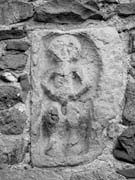
Object type: Small figure carving
Measurements: H. c.60 cm (23.6 in); W. (max.) c.40 cm (15.7 in); D. unknown
Stone type: Greyish orange pink (10R 8/2) mottled with moderate reddish orange (10R 6/6), medium to coarse-grained (0.4 to 0.7 mm), moderately well sorted very friable sandstone. The grains are dominantly quartz which is mainly sub-rounded to sub-angular. Feldspar is common as is mica. The reddish mottling forms streaks diagonally across the slab and may be parallel to the bedding. Probably Bromsgrove Sandstone Formation, Sherwood Sandstone Group, middle Triassic.
Plate numbers in printed volume: Ill. 575
Corpus volume reference: Vol 10 p. 321
(There may be more views or larger images available for this item. Click on the thumbnail image to view.)
Figure carved in low relief against a shallow, cut-back background. The stone on which the figure is carved is straight on the east side and the top, fairly straight at the bottom and irregular on the west side. The figure has a round head with a flat face. The eyes are damaged but the remains of the figure's right eye is large and round. The nose is a broad wedge, while the mouth is little more than a slit. The figure's neck is nearly as wide as the rather narrow chest. The thin arms are carved with the elbows out and hands clasped in front of the body. It is difficult to establish whether the figure is standing or seated, but the latter seems more likely — in which case the knees are rounded, the lower legs quite short and the feet large and downward pointing. There is a filled hole at the point between the figure's legs where it would be possible to establish whether it is male or female.
Appendix A item (stones dating from Saxo-Norman overlap period or of uncertain date)
This carving is normally described as a sheila-na-gig or a fertility symbol. It is possible that the figure holds something square and flat in its hands, a book or box, or perhaps a set of panpipes. If what are described as the knees above are in fact broad, roughly textures thighs, then this could be the figure of Pan with his pipes. The figure is, however, too weathered to be confident about any such interpretation and, as with the majority of these figures, it is not really possible to date this carving with any degree of confidence.
