Select a site alphabetically from the choices shown in the box below. Alternatively, browse sculptural examples using the Forward/Back buttons.
Chapters for this volume, along with copies of original in-text images, are available here.


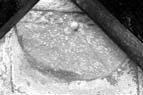
Object type: Sundial
Measurements: Diameter of dial: 30 cm (11.8 in)
Stone type: Yellow/red sandstone
Plate numbers in printed volume: Ill. 537
Corpus volume reference: Vol 10 p. 301
(There may be more views or larger images available for this item. Click on the thumbnail image to view.)
A raised half-circle on a rectangular stone, partly obscured by the gable of the later porch. Four incised dividing lines are visible on the dial and a fifth is apparently obscured by the roof (see below).
Appendix D item (sundials presumed to be of pre-Conquest date).
Taken from a report by Mike Cowham of Cambridge dated 30 May 2007 and pinned up in the porch below the dial.
'The probable date of the dial is around 1050AD. The dial is classed as "Anglo-Saxon", but it may date from as late as 1150AD. This was a period when Norman influence had not fully spread across the country. ... [The dial's] size, position, layout and style all follow the usual pattern for [Anglo-Saxon] dials. ... Most Anglo-Saxon dials were divided into 4, 8 or 16 equal segments, but some are known with 10 segments and a few later ones with 6 or 12. ... The Castle Frome dial is 30 cm (11.8 in) in diameter and is divided into 6 segments [the dividing groove on the extreme right of the dial is masked by the roof], three for the morning and three for the afternoon. This dial has a unique feature. Above the dial itself is [a narrow band of carving consisting of] six Xs in two series of three Xs ...' [either side of a slightly smaller X that is directly above the gnomon hole. The background around the Xs is cut back and each is divided from the next by a vertical raised border. The Xs look a little like flat dogtooth, and this might support a date rather later in the range suggest above].
