Select a site alphabetically from the choices shown in the box below. Alternatively, browse sculptural examples using the Forward/Back buttons.
Chapters for this volume, along with copies of original in-text images, are available here.


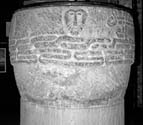
Object type: Font1
Measurements:
H. 50 cm (19.7 in); W. (outside diam.) 72 < 74 cm (28.3 < 29 in)
Font bowl: W. (internal diam.) 53 cm (21 in); D. (of bowl) 26.5 cm (10.4 in)
Stone type: Yellowish grey (5Y 8/1), very hard, well sorted, very fine to fine-grained sandstone. Grains mainly quartz sub-angular to sub-rounded (0.1 to 0.2 mm occasionally 0.4 mm) with a dark mineral which has a ferruginous halo ?glauconite. Matrix appears to be white but this is more probably a white paint or wash as there are patches where no white infill can be seen and the quartz grains are interlocking, possibly re-crystallised. Probably Wrekin Quartzite, early Cambrian.
Plate numbers in printed volume: Ills. 764-7
Corpus volume reference: Vol 10 p. 390
(There may be more views or larger images available for this item. Click on the thumbnail image to view.)
Font with a round-bottomed bowl. The font is decorated in shallow relief with triquetra, knots, debased flat interlace, T-pattern fret and a small, bearded head. The base of this font is a much later (nineteenth-century?) addition.
Appendix K item (Fonts and stoups in the Western Midlands).
In common with the font at Edgmond (see above, p. 384), almost all of the Bucknell design motifs are pre-Conquest in nature. The wide, T-pattern fret carved continuously around the bowl is similar to that on a late ninth-/tenth-century cross fragment from Collingham in western Yorkshire (Coatsworth 2008, 123, ill. 156) and on tenth-century grave-cover fragments from Lowther in Westmorland (Bailey and Cramp 1988, 132, ills. 457, 459, 462). It is also very similar to the design on the side face of the late tenth-/early eleventh-century panel cross from St Arvans, Monmouthshire (Redknap and Lewis 2007, 510–15, cat. MN5), on the side face of the tenth-century cross from Penmon, Anglesey (Edwards 1999, 7–8, fig. 3), and on the tenth-century Olaf Liotulfson's Cross from Ballaugh, Isle of Man (Cubbon 1983, 21, illus.). The step pattern or simple flat cable that is carved above the meander can also be found at Lowther and on a tenth- to eleventh-century cross-shaft fragment from Kirkby Stephen, Westmorland (Bailey and Cramp 1988, 123, ills. 403, 405). The wide area of carving around the top of the font contains interlaced knots, triquetra, and a long horizontal double strand interlaced with short vertical strands. The terminals for both the horizontal and the vertical strands are finished with interlaced loops. However the small bearded face (presumably that of John the Baptist) on what is probably the front of the font looks more like an early Romanesque face, and this font should probably be seen as an example of Saxo-Norman Overlap carving.
The dimensions of the bowl are similar to several other fonts that might have originally been set on the ground or on a plinth without a stem.
[1] There are, beside the Deerhurst font in Gloucestershire which has been shown to be of ninth-century date (Deerhurst St Mary 3, p. 163, Ills. 132–44, 740), a number of fonts in the study area that have been said to be Anglo-Saxon or could be Anglo-Saxon. There are also objects like Bisley All Saints 6 (below, Ills. 732–4) that has been described as a font fragment, and Kenchester 1 (p. 382, Ills. 735–6) that now functions as a font, but that are much smaller than all of the other vessels and may, therefore, have originally been used as stoups or lavabo bowls (see below, and 'Further thoughts on fonts' in Chapter V, pp. 62–4, Table 1). In the following Appendix three vessels that were probably stoups have been listed first, followed by the fonts in chronological order by form (cylindrical tub fonts, square tub fonts, tapering or cone-shaped fonts, and bowl-shaped fonts). Some clearly belong to the Overlap period but are included because they show continuity of form and decoration into the later decades of the eleventh century and beyond.
The tub font at Deerhurst is the earliest securely datable font, and an eighth-century Anglo-Saxon ivory panel in the Victoria and Albert Museum that depicts the baptism of Christ also show a tub font (Beckwith 1972, 119, cat. 5, ill. 20). Tub fonts have, therefore, been placed first in the catalogue below. However, in the south-west of England the earliest surviving fonts are bowl-shaped (copies of domestic bowls) and it seems inherently likely that both tubs and bowls were in use at the same time (Cramp 2006, 38; Blair 2010).
Many of the western Midlands fonts seem to have been carved from newly worked stone, but several are carved into reused Roman capitals and bases. One of the reused Roman bases (at Woolstaston, Shropshire), almost certainly came from the Roman city of Viroconium (Wroxeter) but, unlike the similarly reused bases at Wroxeter St Andrew and Shrewsbury Abbey (pp. 390, 389, Ills. 762–3, 768–70), this vessel has been very crudely reshaped and the bowl is only 8 cm deep (p. 386, Ills. 756–7). It does not look like a font at all but it would, in fact, be ideal for the baptism of adults by affusion or aspersion. Adult baptism must have been very rare by the later Anglo-Saxon period, so it seems possible that the Woolstaston font might be very early, perhaps even sub-Roman.
