Select a site alphabetically from the choices shown in the box below. Alternatively, browse sculptural examples using the Forward/Back buttons.
Chapters for this volume, along with copies of original in-text images, are available here.


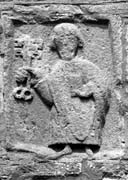
Object type: St Peter panel
Measurements: H. c.50 cm (19.7 in); W. c.41 cm (16.1 in); D. unknown
Stone type: Pale red (10R 6/2), clast-supported, non-calcareous, moderately sorted, quartz sandstone. The grains, which vary in size from 0.2 to 0.5 mm, are sub-angular to sub-rounded and are mostly clear quartz, but there are a few pink quartzite grains. St Maughan's Formation? (Lower Old Red Sandstone Group, Old Red Sandstone Super Group), early Devonian.
Plate numbers in printed volume: Ill. 502; Fig. 32D
Corpus volume reference: Vol 10 p. 283-4
(There may be more views or larger images available for this item. Click on the thumbnail image to view.)
None. Visible in the present position in an eighteenth-century print (reproduced by Pearson 1993, 55) and probably in this position since the twelfth century.
Carved panel in quite high relief. St Peter wears a draped over-garment over a long-sleeved, full-length tunic. He carries two keys held up in his right hand and a book in his left hand. His head is rather egg-shaped with short, 'bobbed' hair, a beard and possibly a moustache. His feet are long and thin and rest across the lower border of the panel. The border itself is square but rises slightly in a curve to the left (figure's right) of the feet.
The proportions of this small figure are similar to those of the figures on the fragments of what was probably a sarcophagus from Breedon-on-the-Hill, Leicestershire (Cramp 1977, 218, fig. 59). The exaggeratedly long right foot, a feature sometimes said to only occur in later medieval carving, can also be paralleled by the similarly long thin feet of St Peter in the late tenth-century Benedictional of St Æthelwold (British Library, MS Add. 49598: Prescott 2002, fol. 4), and by the excessively long fingers on many of the figures on the early cross from Aukland St Andrew, Co. Durham (Cramp 1984, 37–40, pls. 3.5–6, 4.9–10, 5.13–15). Bromyard was an episcopal minster in the mid ninth century when Bishop Cuthwulf leased land between 840x52 to Ealdorman Ælfstan with reversion to the community at Bromyard (Sawyer 1968, no. 1270; Sims-Williams 1990, 169); the community also received a minor bequest under the will of Wulfgeat of Donington c. 1000 (Sawyer 1968, no. 1534). In Domesday Book Bromyard was an important episcopal holding assessed at 30 hides; two priests are mentioned (Thorn and Thorn 1983, no. 2,49). The carving is described by Zarnecki as 'rustic work, so incompetent that even the rectangular border of the slab is not straight at the bottom' (Zarnecki 2008a). However, the present author believes that the carving of the figure is quite delicate and that the frame was specifically designed to be set partly over a curving feature. One location for such a panel might have been as part of a frieze of figures across the top of an arch, perhaps the chancel arch in an Anglo-Saxon church that predated the present twelfth-century building.
