Select a site alphabetically from the choices shown in the box below. Alternatively, browse sculptural examples using the Forward/Back buttons.
Chapters for this volume, along with copies of original in-text images, are available here.


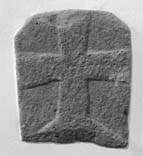
Object type: Grave-marker
Measurements: H. 40.5 cm (15.9 in); W. 35 > 31.5 cm (13.8 > 12.4 in); D. (visible) 2.5 cm (0.9 in)
Stone type: Pinkish grey to light brownish grey (5YR 7/1) hard, poorly sorted, very pebbly, coarse to very coarse-grained sandstone (0.2 to 2.0 mm). The sand grains and pebbles consist dominantly of quartz and are sub angular to sub rounded but with some rounded grains. One pebble looks like a fine-grained quartzite. Bedding is probably parallel to the face of the slab. Possibly Clee Sandstone Formation, Woodbank Group, Lower Old Red Sandstone (Lower Devonian).
Plate numbers in printed volume: Ill. 542
Corpus volume reference: Vol 10 p. 306
(There may be more views or larger images available for this item. Click on the thumbnail image to view.)
Plain grave-marker. The stone is tapered with a flattish top and chamfered upper corners. The visible face of the stone is carved with a cross in shallow relief. The cross stands on a low, gable-like 'hill'. The cross-head is a slightly irregular B6 type with the cross-arms and top arm tapering inwards from 11–10 cm to 8–7.5 cm (4.3–3.9 in > 3.1–2.9 in) and the stem tapering upwards from 10 to 8 cm (3.9 > 3.1 in).
The weathered face of this stone indicated that it was set up outside the church. The style is so close to one of the stones from Shrewsbury (St Mary 2, p. 309, Ills. 551–2) that it seems reasonable to assume that both grave-markers are similar in date. The tenth-century parallels noted for Shrewsbury St Mary 2 could therefore, by extension, be applied to the Bromfield headstone. The low, slope-sided 'hill' or calvary on which the cross stands is in particular similar to that on face C on the tenth-century cross-base no. 12 from Chester-le-Street in Co. Durham (Cramp 1984, 58–9, pl. 28.148–9).
In 1060–1 King Edward the Confessor issued a writ in favour of St Mary's minster and 'my clerks' at Bromfield, granting judicial and financial rights over their lands (Sawyer 1968, no. 1162; Harmer 1959). Domesday Book records that before 1066, there were 20 hides of land held by twelve canons, though 10 hides were being used to support a royal clerk and subsequently a secular royal official (Thorn and Thorn 1986, nos. 3d, 6, 7). Bromfield acted as the mother church of an extensive area, and it is likely to have been a minster of some antiquity (Gaydon 1973, 27–9; Blair 1985, 128–31).
