Select a site alphabetically from the choices shown in the box below. Alternatively, browse sculptural examples using the Forward/Back buttons.
Chapters for this volume, along with copies of original in-text images, are available here.


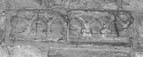
Object type: Fragment of probable string-course
Measurements: H. c.13 cm (5.1 in); W. c.48 cm (18.9 in); D. unknown
Stone type: Sandstone, friable, moderate reddish brown (10R 6/6 to 10R 7/4) well sorted, very fine- to fine-grained (0.1 to 0.2 mm) with some well rounded quartz grains. Some feldspar grains. Bridgnorth Sandstone Formation, early Permian.
Plate numbers in printed volume: Ill. 572
Corpus volume reference: Vol 10 p. 320
(There may be more views or larger images available for this item. Click on the thumbnail image to view.)
Noted by Cranage (1894–1912, I, 5, 8) as having been discovered some 30 years previously (i.e. in the 1860s). The stone was presumably built into its present position during the complete rebuilding of the tower in 1870–3 (Newman and Pevsner 2006, 161).
Fragment of string-course, or possibly the edging for a grave or altar slab, decorated with interlocking arcading that rises from rectangular imposts. The carving is in shallow relief.
Appendix A item (stones dating from Saxo-Norman overlap period or of uncertain date)
Three sections of what was probably an arcaded string-course have been reused high in the inner face of the ringing chamber in the tower. The interlocking arches are similar to those on one of the canon tables in the early eleventh-century Bury Gospels (British Library, MS Harley 76: Temple 1976, 93, cat. 75, ill. 230). However, interlocking arcading is also a feature of early twelfth-century Norman architecture and these string-course fragments could therefore belong to either the late Anglo-Saxon or Norman period. As noted in the entry for Bridgnorth 4 in Appendix C below (p. 326), Cranage distinguishes between this carving (and nos. 2 and 3) and other early (possibly Anglo-Saxon) carvings that were discovered in the tower at the same time but subsequently lost (Cranage 1894–1912, i, 5).
