Select a site alphabetically from the choices shown in the box below. Alternatively, browse sculptural examples using the Forward/Back buttons.
Chapters for this volume, along with copies of original in-text images, are available here.


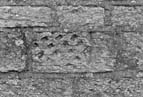
Object type: String-course fragment
Measurements: H. 12.5 cm (4.9 in); W. 26.5 cm (10.4 in); D. unknown
Stone type: Light grey (N7) (but with a slight yellowish tinge), bedded, sparry matrix-supported, shelly oolites; The bedding is horizontal. The ooliths are medium-grained and range from 0.3 to 0.8 mm; there are thin, platy, bivalve fragments up to 5 mm across. White Limestone Formation, Great Oolite Group, Middle Jurassic.
Plate numbers in printed volume: Ills. 50, 52; Fig. 20L
Corpus volume reference: Vol 10 p. 142
(There may be more views or larger images available for this item. Click on the thumbnail image to view.)
Daubeny (1921, 211) wrote that beneath the east window of the chancel 'are several stones whose surfaces are broken by diagonal shallow pits or depressions, considered to be indicative of Roman work: these were dug up in the churchyard, together with a number of potsherds, and other Roman fragments'; he was presumably referring to Bisley 2 and 3. The surrounding masonry shows no sign of any disturbance which might have resulted from the insertion of these fragments, and it seems unlikely that they could have been built into the wall at any date since the major restoration of 1860–2. It is unclear what evidence may have been available to Daubeny, and it is perhaps more likely that the fragments were discovered during the partial restoration of the chancel in 1851 or during the restoration of the whole church in 1860–2 (Verey and Brooks 1999, 174–6).
The northern of two fragments. There is a wide plain border at the north end, 8 cm (3.1 in) wide, with a narrow border on the lower edge 2.7 cm (1.1 in) wide. The panel is decorated with a well-executed five-strand interlace or plait consisting of two paired strands and a single strand. At the end of the panel the paired strands are linked through simple U-bends, while the single strand is turned and tucked under one of the U-bends.
This interlace panel is the terminal block of a string-course, bounded at the bottom by a plain, square-section border. It is reasonable to assume that there was a similar border along the upper part of the stone, now missing. A second panel of interlace (Bisley All Saints 3, Ill. 51) survives in the same course of stones about 1.60 m (5.2 ft) to the south of this stone, and three stones in the course immediately below also show some traces of interlace (Ill. 52). The three stones are 16.5 cm high x 45.5 cm (6.5 in x 17.9 in); 16.3 cm high x 47.2 cm (6.4 in x 18.5 in), and 15.5 cm high x 48 cm (6.1 in x 18.9 in). The two courses are, in fact, quite similar and it is possible that many of these stones were taken from the same string-course. Together with Bisley All Saints 4a–b (Ill. 53), two joining fragments from a second string-course, they clearly represent part of a building now lost. If the two string-courses were contemporary, then a date in the tenth century would be most likely, although carefully designed interlace panels are certainly present in Gloucestershire by the ninth century.
Bisley is mentioned in a document of 896 in a context which implies that it was a significant estate centre at that date (Sawyer 1968, no. 1441; Hooke 1985, 87). It has been suggested that Bisley was the site of a minster church (Hare 1990).
