Select a site alphabetically from the choices shown in the box below. Alternatively, browse sculptural examples using the Forward/Back buttons.
Chapters for this volume, along with copies of original in-text images, are available here.


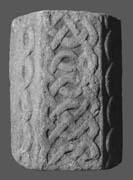
Object type: Incomplete grave-cover
Measurements: L. 57.5 cm (22.6 in); W. 42 cm (16.5 in); D. 22.5 cm (8.8 in)
Stone type: Yellowish grey (5Y 8/1) shelly oolite with grains supported by sparry matrix. The ooliths range from 0.2 to 0.8 mm and the shell debris is up to 1 cm in size. There are signs of bedding across the slab parallel to the top and bottom. White Limestone Formation, Great Oolite Group, Middle Jurassic.
Plate numbers in printed volume: Ills. 45-9
Corpus volume reference: Vol 10 p. 141-2
(There may be more views or larger images available for this item. Click on the thumbnail image to view.)
Unknown. Noticed by Michael Hare in the front hall of the old vicarage (on the north-east side of the churchyard) as it was being cleared prior to sale c. 1980, and subsequently moved to the church. The old vicarage was itself built in 1831–2 (Verey and Brooks 1999, 176).
Chamfered grave-cover with interlace decoration.
A (broad): The upper face (22.2 cm / 8.7 in wide) is decorated with wide bands of median-incised interlace in a chain of interlocking figure-of-eight, lozenge-shaped loops (simple pattern F). Enmeshed in the loops, just below the centre point of the stone, is a separate lozenge-shaped free ring with rounded corners.
B and D (narrow): The chamfered faces are 13.5 cm (5.3 in) and 14 cm wide (5.5 in) respectively, and each is decorated with two median-incised strands loosely twisted together.
The side walls below the chamfered faces are plain. The two faces are of different depths, one being 12 cm (4.7 in) deep and the other 12.9 cm (5.1 in) deep. This is because the two chamfered faces are cut at slightly different angles.
C and E (ends): One end of the slab is damaged, but the other is cut square.
F (bottom): The base of the stone has been cut away for later reuse as a trough or drain.
The pattern on the upper face is incomplete at both ends, and indicates that the original grave-cover consisted of three or more stones. The figure-of-eight design, with or without the free ring, is a widespread motif from the late tenth and eleventh centuries (e.g. the Kesteven and Lindsey grave-covers from Lincolnshire and neighbouring counties: Everson and Stocker 1999, 35–62). This design can also be seen on Bisley All Saints 4, and on several of the eleventh-century Bibury gravestones. The lozenge or diamond form is rather unusual, but diamond-shaped terminals are used on the eleventh-century gravestone from Ampney St Mary (no. 1, Ill. 3).
