Select a site alphabetically from the choices shown in the box below. Alternatively, browse sculptural examples using the Forward/Back buttons.
Chapters for this volume, along with copies of original in-text images, are available here.


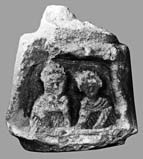
Object type: Lower arm of cross-head
Measurements: H. 18 cm (7.1 in); W. 15.5 cm (6.1 in); D. 9 cm (3.5 in)
Stone type: Pale yellowish orange (10YR 7/6) oolite with gains supported in a muddy matrix with very sparse shell debris. Oolith range in size from 0.2 to 0.3 mm and many are hollow. Any shell debris is less than 2 mm in size. Cleeve Cloud Member, Birdlip Limestone Formation, Inferior Oolite Group, Middle Jurassic.
Plate numbers in printed volume: Ills. 58-9; Fig. 34E
Corpus volume reference: Vol 10 p. 146
(There may be more views or larger images available for this item. Click on the thumbnail image to view.)
Unknown, but thought in 1938 to have been discovered on the Lypiatt Park estate. The stone was kept with a number of Roman altars in the chapel at Lypiatt Park until 1947, when the altars, together with this fragment, were transferred to Stroud Museum (Clifford 1938, 297–8, fig. 28; Walrond 1993).
Wedge-shaped lower arm from a cross-head.
A (broad): There is a recessed panel on this face c. 1 cm (0.4 in) deep, surrounded by a wide, plain border. In the panel, two figures are depicted, a man and a woman. The man's face is rather 'egg'-shaped, with large eyes and a prominent nose. His hair is curly. He wears a cloak draped over his left shoulder and pulled across to fasten on his right shoulder. His garments are heavily pleated. The woman is of similar size, with a slightly larger head. Her face is squarer than the man's, but her eyes and nose are similar. Her hair is bunched in rolls across the top of her head. Her cloak is drawn over both shoulders and fastened in the centre of her chest. Her garment is, like the man's, heavily pleated. The figures hold their arms out stiffly, but towards each other.
B and D (narrow): Plain, carrying only diagonal tooling.
C (broad): Also plain, but covered with coarser tooling that suggests that it may have been cut back.
The stone is wedge-shaped and carved at the top to form a narrower 'necking', with a broken upper face showing where it had once been joined to the rest of the cross-head. This may be a B12 type cross-head (Cramp 1991, fig. 2), but not enough survives to be certain of the overall form. There is a scar on the bottom face of the stone, the remains of the joint between the head and the top of the cross-shaft. The figures are dressed in the clothing style of the late eighth or ninth century (Henig 1993, 78), and may be patrons. In previous publications it has, however, been assumed that the figures represent Adam and Eve, but they are clothed rather than naked as they are traditionally depicted and as they appear on the cross-shaft from Newent (Newent 1, Ills. 392, 398). An alternative interpretation might, therefore, be that they are the Virgin Mary and St John at the foot of the cross, with St John leaning forward to take hold of Mary's hands in an act of filial compassion in response to Christ's dying request. A similar interpretation could be placed upon the figures of the Virgin and St John in a manuscript illumination from a mid eleventh-century Psalter from Winchester. In this image neither St John nor the Virgin are looking at Christ on the cross but at each other, and St John is reaching out towards Mary (British Library, MS Arundel 60, fol. 12v: Temple 1976, 120, cat. 103, ill. 312). It has been pointed out before (Walrond 1993, 38; Henig 1993, 78) that the style of the figure carving is very similar to that used on the late eighth- to early ninth-century cross-shaft and base from Auckland St Andrew, Co. Durham (Cramp 1984, 37–40, pls. 1–5).
