Select a site alphabetically from the choices shown in the box below. Alternatively, browse sculptural examples using the Forward/Back buttons.
Chapters for this volume, along with copies of original in-text images, are available here.


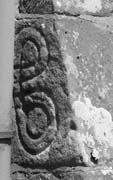
Object type: Stone with incised knot motif
Measurements: H. 34 < 35 cm (13.4 < 13.8 in); W. 14 < 26 cm (5.5 < 10.2 in); D. 16.5 cm (6.5 in)
Stone type: Pale brown (5YR 5/2), medium-grained, non-calcareous, clast-supported, sandstone. The sub-angular to sub-rounded grains are mostly clear quartz, but about 10% are white quartzite; the grains vary from 0.2 to 0.5 mm across. Brownstones Formation? (Lower Old Red Sandstone Group, Old Red Sandstone Super Group), early Devonian.
Plate numbers in printed volume: Ill. 536
Corpus volume reference: Vol 10 p. 297
(There may be more views or larger images available for this item. Click on the thumbnail image to view.)
Stone with incised square-knot motif. The deeply incised lines may be pecked rather than scored.
Appendix A item (stones dating from Saxo-Norman overlap period or of uncertain date)
This motif is similar to carvings on several stones in the Welsh Corpus: Ewenni 2, Merthyr Mawr 11 and Newcastle 2, all in Glamorgan (Redknap and Lewis 2007, 295–6, 483, 488–91). The Llangarron carving is also similar to one of the motifs on an overlap-period tympanum from Rowston, Lincolnshire (Everson and Stocker 1999, 314, ill. 493) and, in western Mercia, to one of the stones from Shropshire (Diddlebury 2, p. 322, Ill. 576).
The Book of Llandaf includes a claim that Llangarron was one of eleven or twelve churches restored by King Ithel to Bishop Berthwyn after Saxon devastation in the Hereford area (Evans and Rhys 1893, 192); if an authentic record lies behind this report, a church at Llangarron in the mid-eighth century would be indicated (Davies 1978, 176).
