Select a site alphabetically from the choices shown in the box below. Alternatively, browse sculptural examples using the Forward/Back buttons.
Chapters for this volume, along with copies of original in-text images, are available here.


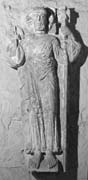
Object type: Carved figure in high relief
Measurements: H. 153 cm (60.1 in); W. (max.) 72 cm (28.3 in); (at base) 35.5 cm (14 in); D. (of carving at head) 16 cm (6.3 in); (of backing stone) 7 cm (2.8 in)
Stone type: Oolitic limestone
Plate numbers in printed volume: Ill. 729
Corpus volume reference: Vol 10 p. 374-5
(There may be more views or larger images available for this item. Click on the thumbnail image to view.)
Carved figure of Christ in high relief. This fine figure, carved onto five carefully jointed stone panels, depicts Christ with a long-staff cross in his left hand and his right hand held up in blessing with two fingers raised and the others folded across his palm. Christ's feet are resting on a sloping suppedaneum. His bearded face is long, with full lips, a straight nose and large, slightly bulbous eyes. The hair is short. Behind Christ's head is a crossed halo. The right arm is raised straight up from the elbow, with the folds of the right sleeve pushed back. The left arm is raised at a rather awkward angle and again the sleeve fall away from the forearm and wrist. The hand is well-modelled with the fingers wrapped around the stem of the cross. The head of the cross is a recent replacement. The figure wears a full-length, round-necked garment that is caught up into a band of folded cloth around the waist before falling in delicate folds down across the figure's right thigh. The hem of the garment is covered with an intricate series of interleaving folds. The figure still bears fairly widespread traces of deep red and blue/black polychromy.
Appendix A item (stones dating from Saxo-Norman overlap period or of uncertain date)
A range of different dates have been suggested for this figure, from as early as the mid-eleventh century (Tudor-Craig 1990, 230–1; Bridges 2005, 142–3) to as late as c. 1220. This last was proposed by Pevsner, but he also claimed that the carving was a reset coffin lid which it quite clearly is not (Pevsner 1968, 212, pl. 19, which shows the figure in its earlier external setting on the north wall). The sculpture was restored in 1970 by the V&A and they proposed a date of c. 1100. There are three other monumental figures in nearby Gloucestershire and Bristol that offer potential comparisons for the Leigh Christ. However, the figure of Christ at Beverstone (second half tenth century) is carved with delicate flying drapery, a twist in the body and the arms spread in blessing (no. 1, p. 133, Ills. 25–6), while at Bristol (first half eleventh century), a vigorous Christ Harrowing Hell is full of dynamic movement (Cramp 2006, 145–6, ill. 198; this volume, Ill. 786). Only the carefully modelled arm and hand from the lost mid eleventh-century monumental crucifixion at Bitton (no. 2, p. 147, Ills. 68–75) suggests something of the same majestic stillness that is found in the Leigh figure. The in situ feet of the Bitton figure, on a sloping suppedaneum like those at Leigh, are also very similar, but not enough survives to be able to make any more detailed comparisons (no. 1, p. 147, Ill. 67). Therefore, while it is possible that the Leigh Christ might have been carved in the mid-eleventh century, the date of c. 1100 is perhaps more likely.
