Select a site alphabetically from the choices shown in the box below. Alternatively, browse sculptural examples using the Forward/Back buttons.
Chapters for this volume, along with copies of original in-text images, are available here.


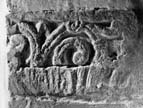
Object type: Cross-shaft fragment
Measurements: H. 13 < 14 cm (5.1 < 5.5 in); W. 32.7 cm (12.9 in); D. 11 < 11.5 cm (4.3 < 4.5 in)
Stone type: Yellowish grey (5Y 7/2), poorly sorted, matrix-supported, oolitic shelly limestone. Shell fragments, up to 3 mm across, vary from platy to sub-rounded — they form about 35% of the rock. The ooliths, ranging from 0.3 to 0.7 mm diameter, form about 40% of the rock; most have fallen out to give an 'aero-chocolate texture. Ooliths set in a crystalline sparry cement. Taynton Limestone Formation?, Great Oolite Group, Jurassic. Possibly Combe Down Oolite.
Plate numbers in printed volume: Ills. 384-5; Fig. 30E
Corpus volume reference: Vol 10 p. 230-1
(There may be more views or larger images available for this item. Click on the thumbnail image to view.)
On the occasion of a visit to Iron Acton by the Bristol and Gloucestershire Archaeological Society in July 1919, the rector (Canon G. R. Browne) reported that 'When the former Bishop of Bristol (Dr. Forrest Browne) was in the church he noticed at once a Saxon stone, and pointed out that it had been built into the wall upside down' ((—) 1918–19, 125). Dr George Forrest Browne was bishop of Bristol from 1897–1914.
Part of the top of a cross-shaft decorated with a loose, median-incised plant-scroll. Part of the plain square side and top frames survive, and one volute of the scroll is attached to the side frame by a rounded, 'U'-shaped or 'domed' clip. A triangular bud grows from the separation point of two volutes on the plant-scroll. The volute terminals, and a side-shoot that fills the top corner of the shaft, have lobed tips.
Plunkett included the Iron Acton fragment in his 'Colyton school' of late tenth-century sculpture, comparing it to examples from Colyton itself (Devon), Littleton Drew (Wiltshire), Todber (Dorset), and Chew Stoke and Nunney (Somerset) (Plunkett 1984, i, 202–12). Cramp summarised the features of this 'school' (Cramp 2006, 51–5, fig. 22) within a wider summary of acanthine ornament. Specific parallel features, such as the 'domed' or 'U'-shaped clips occur also on no. 7 from Bath (Cramp 2006, 142–3, ills.185–7), and all the features, together with the overall composition, that appear on the Nunney cross-shaft, face 1A (Cramp 2006, 173–4, ill. 316) appear also on the Iron Acton shaft.
