Select a site alphabetically from the choices shown in the box below. Alternatively, browse sculptural examples using the Forward/Back buttons.
Chapters for this volume, along with copies of original in-text images, are available here.


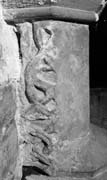
Object type: Cross-shaft fragment
Measurements: H. 34 cm (13 4 in); W. 29 > 27 cm (11.4 > 10.6 in); D. 15 cm (5.9 in)
Stone type: The stone has a highly patinated surface with no clear section. Yellowish grey (5Y 7/2), matrix-supported, shelly oolite. Ooliths vary from 0.2 to 0.4 mm and are cut across (i.e. have not fallen out) set in a crystalline calcite matrix; sub-rounded shell fragments up to 0.6 mm occur. Gryphite Grit Member?, Birdlip Limestone Formation, Lower Inferior Oolite Group, Jurassic.
Plate numbers in printed volume: Ills. 382-3, fig 43
Corpus volume reference: Vol 10 p. 229-30
(There may be more views or larger images available for this item. Click on the thumbnail image to view.)
Noted in its present position by Bethell (1888–9, 11).
This stone is part of a cross-shaft, with the remains of interlace on two faces (faces A and C). The front of the stone has been cut back and chamfered off so that no decoration survives. The chamfered base of the pulpit shaft is a separate stone. It is unclear to what extent the carved stone is bonded into the wall. Face A carries median-incised interlace which can be disentangled to a degree but adds little to the meaning of the piece. However, the carving on face C appears to be part of a turned and possibly encircled design constructed on a grid that runs diagonally across the surviving faces of the fragment.
The taper on this stone may indicate that it originally stood as it now stands, and in which case, it was originally a small cross-shaft of square or rectangular plan. However, there is some indication that the piece has been turned through 90 degrees and that it should be viewed as an obliquely broken fragment of a much larger cross-shaft with a slightly irregular, rectangular cross-section. This suggestion is derived from an attempt to reconstruct the decoration on face C (see description above and Fig. 43). If this interpretation is correct, a date in the tenth century would be appropriate. It has to be acknowledged, however, that so little of the decoration remains that other reconstructions would be possible, and, although undoubtedly Anglo-Saxon, slightly earlier or later dates for the stone might as a consequence be suggested.
William of Malmesbury's Vita Wulfstani relates that as a young man, Wulfstan (future bishop of Worcester, 1062–95) was appointed to the church of the vill of Hawkesbury. It has been argued that there was a small minster community at Hawkesbury (Hare 2005).
