Select a site alphabetically from the choices shown in the box below. Alternatively, browse sculptural examples using the Forward/Back buttons.
Chapters for this volume, along with copies of original in-text images, are available here.


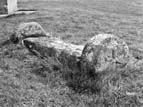
Object type: Grave-cover and grave-markers
Measurements:
1a. Grave-cover: L. 75 cm (29.5 in); W. 37 > 33 cm (14.5 > 13 in); D. 14 cm (5.5 in)
1b. Western grave-marker (headstone): H. (visible) 24 cm (9.4 in); W. 36 cm (14.1 in); D. 16 cm (6.3 in)
1c. Eastern grave-marker (footstone): H. (visible) 21 cm (8.3 in); W. 38 cm (15 in); D. 16.5 cm (6.5 in)
Stone type: The description is based on the eastern stone (1c), which is flaking quite badly; the western stone (1b) is similar, but was not examined in detail. The central stone (1a) is too badly weathered and lichen-encrusted for detailed examination. The stone is yellowish grey (5Y 7/2), clast-supported, shelly micrite. Clasts range from 0.3 to 5.0 mm; they include recognisable fragments of bivalves, cidarids and bryozoa. Aston Limestone Formation? Inferior Oolite Group, Jurassic.
Plate numbers in printed volume: Ills. 379-81
Corpus volume reference: Vol 10 p. 228-9
(There may be more views or larger images available for this item. Click on the thumbnail image to view.)
Very probably in situ. Noted in present position by MacKay (1963, 91, pl. 4).
A small grave-cover with semicircular-topped grave-markers at the head and foot. The slab itself is tipped slightly to the south. The outer faces of both head and foot stones are carved with raised equal-arm B6 crosses with wedge-shaped arms, and the slab bears a similar raised cross with a long stem down the centre of the slab. MacKay indicated that 'traces of interlace [could be seen] on one end-stone and of a cross patée with bifurcated terminals on the other' (MacKay 1963, 93). However, no interlace could be found by the present author and it is suggested that MacKay misinterpreted the damaged remains of the cross on the footstone.
This grave ensemble, possible marking the grave of a child, resembles the mid tenth- to eleventh-century grave ensembles with recumbent slabs and end-stones that were found in situ during 1966–71 excavations under the south transept of York Minster, although the stones there bear an earlier style of ornament and some had been reused (Lang 1991, 39–40, ills. 416–17). A tenth- to eleventh-century grave-marker (York Minster 28) from the same excavations carries, in low relief on both faces, equal-arm B6 crosses with wedge-shaped arms which stand on narrow stems similar to that on the Haresfield grave-cover (ibid., 68, ills. 115, 117). Semicircular-headed grave-markers bearing similar raised crosses with wedge-shaped arms can also be found in Gloucestershire at Brimpsfield (no. 1, Ills. 85–6), as well as sites like Stedham in Sussex (for example no. 7 in Tweddle et al. 1995, 196, ills. 243–4), and can be late Anglo-Saxon in date. The B6 cross type is also found incised on eleventh-century grave-covers from Carlby in Lincolnshire (Everson and Stocker 1999, 126–7, ills. 84, 86, 87). While acknowledging that semicircular-topped end-stones and the B6 type of cross have a long life, the whole ensemble at Haresfield strongly suggests a late Anglo-Saxon date in the eleventh century.
