Select a site alphabetically from the choices shown in the box below. Alternatively, browse sculptural examples using the Forward/Back buttons.
Chapters for this volume, along with copies of original in-text images, are available here.


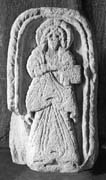
Object type: Three-dimensional sacred image
Measurements: H. 49 cm (19.3 in); W. 26 < 27 cm (10.2 < 10.6 in); D. 9 < 20.5 cm (3.5 < 8 in)
Stone type: Pale greyish brown (10YR 6/2) very shelly oolite with a sparry matrix. Mainly matrix supported. Very shelly on bedding surface which is parallel to main faces. Oolith size 0.1 to 0.6 mm. Shell debris mainly up to 5 mm but some 10 mm. Shell debris consists of bivalves and gastropods with some bryozoa and cidarid spines. Some patches of paint or lime wash. Taynton Limestone Formation, Great Oolite Group, Middle Jurassic.
Plate numbers in printed volume: Ills. 635-45; Figs. 27D, 27G, 34F
Corpus volume reference: Vol 10 p. 357-9
(There may be more views or larger images available for this item. Click on the thumbnail image to view.)
None. When Baldwin Brown first published the Lechmere Stone, he wrote that 'Its history is unknown except in so far as its presence at Severn End goes back beyond any memories or records, and may run to centuries' (Brown, G. 1931, 226–8). No information about the provenance of the stone has subsequently come to light. Severn End is the ancestral home of the Lechmere family.
Small free-standing object. The lack of any evidence for weathering suggests that this piece was an element of the interior furnishing of a church. The stone tapers upwards, and is flat at the bottom and rounded at the top. It is carved on front, back and side faces, and the stability of the stone would have been enhanced by the way in which it has been 'flared-out' towards the base of face C. There are traces of limewash over much of the stone. There is no sign of a jointing socket in the flat base.
A (broad): The figure of Christ stands fairly closely confined within a double border. The inner border consists of a plain roll moulding, while the outer border is decorated with a wide cable. The figure stands proud of the borders by 1 cm and by 2.5 cm from the background. Christ is clothed in a wide-necked, full-skirted tunic and voluminous over-garment. The tunic falls in radiating folds with 'spreading triangular pleats' (Kendrick 1938, 186–7). The main folds of the outer garment copy those around the hem of the tunic, before continuing down the sides of the figure. All these folds are taken around on to the side faces of the figure. The over-garment has a wide flat collar and is open to the waist where it is pulled across to pass below the figure's left hand. The visible sleeve is full and rounded, but tight around the forearm and wrist. Alternatively, the rounded upper part of the sleeve might be part of the over-garment, pulled back to the elbow to expose the tighter sleeve of the tunic. The head of Christ is long and narrow, with a rounded forehead and deeply drilled eyes. The mouth is now little more than a horizontal indentation and the nose is missing. What looks like a wide nostril is, in fact, a natural hollow in the stone. The hair is thick over the top of Christ's head and falls to either side in shoulder-length curls. A large, slightly dished, cruciferous halo rises behind the head and sits upon the figure's shoulders. Christ holds a book in his left hand, while his right hand rests on the top of the book in a gesture of blessing. His downward-pointing feet poke out from under the hem of his tunic and cross the lower border of the stone. Baldwin Brown (Brown, G. 1931, 226) wrote that 'The orbits of the eyes, now hollow, seem to have been filled in with some substance of a dark blue colour which has left traces'. However, after detailed examination by the present author and colleagues, no trace of any colour in the drilled eyes could be found.
B and D (narrow) and E (top): The sides and top of the stone carry deeply cut plant-scrolls that rise up each side to meet on the top. The plant-scrolls are set within double borders, the inner being narrow and plain and the outer being those that form the outer borders on faces A and C. The lower parts of the side stems have complete volutes, while, on the narrower upper part of the stone, the main stems become sinuous curves. Long, narrow, serrated leaves hang down from the volutes and from the main stems. Round fruit sprout from the stalks of the leaves in opposed pairs or in clusters. The interstices at the stem junctions are filled with oval, pointed-oval or figure-of-eight fruits.
C (broad): This face is dominated by an encircled or wheel-headed, 'leaved' cross of type E9 on a stepped base, carved deeply (3 cm) into the stone. Around the edge there is a plain, round-section border that widens at the bottom, with the inner edge curving in to form a curved, recessed area around the foot of the cross similar to that around the cross-head. The shaft stands on a double-tier base and consists of two bellied sections separated by a wide collar. A second collar separates the top of the shaft from the head. The head is a complete circle with a wide rim divided in two by an incised line. Inside the encircling rim, the cross is equal-armed, with curving armpits. The arms are outlined with a continuous incised border, and they curve out to meet the rim where they are finished with in-curving, rounded terminals. The vestigial remains of a flat boss survive at the centre of the cross-head, c. 4.5 cm in diameter, with a small hole drilled into the centre. Either side of the cross-shaft sinuous plant-scrolls rise from square, triple-tiered bases that are set at an angle to the main cross-base. The plant stems bifurcate twice at double-ridged nodes. Long, narrow, serrated leaves with curling tips hang down from the nodes on short stems, from the sides of which sprout pairs of rounded fruits. At the nodes, oval or pointed-oval fruits sprout from between the plant stems to fill the interstices.
(including contributions from J. West)
This small, high quality carving is almost certainly not a headstone or grave-marker as has been suggested (Tweddle 1991c, 245, cat. 210). Instead, the lack of weathering and any visible sign of fixing in the base, together with the distinctive shape of the piece, indicate that the carving was designed to sit upon a flat surface inside a building. The fact that the plant-scrolls on the sides of the stone rise to meet across the top might suggest that this carving was designed to be seen from a relatively low level, but the curving surface of the top of the stone means that, even when viewed from below, some of the upper parts of the plant-scrolls can still be seen. Such a carving, a three-dimensional sacred image that was presumably also painted, might have been set upon a pedestal or raised platform behind the altar, or at a higher level on a flat-topped epistyle-type beam in a screen defining the western boundary of the sanctuary or choir (see also Church Furnishings — Chapter V, p. 61). This last suggestion is supported in a description, by Richard Gem, of work carried out by Pope Hadrian in the mid 770s, to enhance the double presbytery area of St Peter's in Rome. Gem noted that 'both of these areas were marked at their entrance by railings, above each of which the pope erected a beam carrying images of the saints, all encased in silver' (Gem 2011, 27).
Kendrick thought that 'it would be difficult to find anything more typically Mercian that the figure-style of this carving' (Kendrick 1938, 186). The form of the folds in Christ's garments are almost identical to those of Matthew's angel'symbol in the Book of Cerne (Brown, M. 1996, 186, pl. IIa), and to the garments of the Virgin and the procession of figures on three sections of a sarcophagus from Breedon-on-the-Hill, Leicestershire (Cramp 1977, 215, 220–1, figs. 58a, 59a–c). It seems to have been Kendrick (1938, 187) who first compared the head of the Lechmere Christ to those of Adam and Eve, and David and Goliath, on the Newent cross-shaft in Gloucestershire (Newent 1, p. 232, Ills. 392–3, 398–9). The drilled eyes, which might once have been enhanced with coloured paste (see the comment by Baldwin Brown quoted above), have also been seen as a Mercian feature, and Cramp, while observing that this is a widespread fashion in eighth-/ninth-century sculpture from Gloucestershire to Yorkshire and Northumberland, acknowledges that it may have originated in Mercia (in Rodwell et al. 2008, 67, fig. 12). Kendrick also compared the shape of the cross-head to examples from Amesbury (Wiltshire), Rolleston (Staffordshire) and Rowsley (Derbyshire) (Kendrick 1938, 187).[1] The Amesbury cross-head has recently been published in detail by Rosemary Cramp (Cramp 2006, 199–200, ills. 383–7) and it is clear that the shape, if not the decoration, is very similar. The plant-scroll on the edge of the Lechmere Stone finds an almost exact match on the upper and lower border scrolls on the font at Deerhurst in Gloucestershire (Deerhurst St Mary 3, p. 163, Ills. 134, 137). Even the gesture, with which the Lechmere Christ touches the book that he holds in his left hand, is matched by that of Matthew and by Mark in the Book of Cerne (Brown, M. 1996, pls. IIa, IIIa; see Ill. 774 below).
The uncertainty over the provenance of the Lechmere Stone means that it is difficult to place this important piece in any sort of historical context. The Lechmere family had widespread landholdings in the area; for instance in 1839 they held a strip of land adjacent to the churchyard at Elmstone Hardwicke, Gloucestershire, and other small plots of land nearby (Gloucestershire Archives, GDR/T1/79, plan nos. 280, 283, 286); ninth-century sculpture is known from this site (see catalogue entry, p. 198). However, the possibility that the stone originated from an important church in the parish of Hanley Castle should not be overlooked. Steven Bassett (1998, 7–8) has pointed out that it is not easy to study the development of mother churches in the wooded belt of land west of the Severn which in the late medieval period formed Malvern Chase. Hanley Castle was, however, the caput of the forest, later chase, in the twelfth century (Toomey 2001, xii–xiv). It is possible that Hanley Castle's significant administrative role in this area may be much older and that an important early church also existed here.
