Select a site alphabetically from the choices shown in the box below. Alternatively, browse sculptural examples using the Forward/Back buttons.
Chapters for this volume, along with copies of original in-text images, are available here.


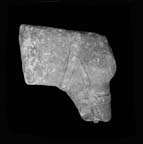
Object type: Prokrossos
Measurements:
Muzzle to top of forehead: H. 36 cm (14.1 in)
Forehead: W. 22 cm (8.6 in)
Forehead to base of neck: D. 41.5 > 38 cm (16.3 > 15 in)
Neck: W. 25 < 25.5 cm at base (9.8 < 10 in)
End of muzzle: H. 11.5 cm (4.5 in); W. 14.5 cm (5.7 in)
Rebate cut in animal's left side and back: W. 14 < 15 cm (5.5 < 5.9 in); D. 6 cm (2.4 in)
Stone type: Pale orange (10YR 8/2) Grain supported oolite with sparry matrix. Ooliths mainly hollow (0.2 to 1.0 mm). Some shell debris mainly up to 3 mm but occasionally 10 mm. Cleeve Cloud Member, Birdlip Limestone Formation, Inferior Oolite Group, Middle Jurassic.
Plate numbers in printed volume: Ills. 371-8; Fig. 29K
Corpus volume reference: Vol 10 p. 227-8
(There may be more views or larger images available for this item. Click on the thumbnail image to view.)
In 1893–4 the Gloucester Tolsey was demolished (at the south-west corner of the central cross-roads in Gloucester). The demolition revealed several phases of the building of the former church of All Saints, Gloucester. The animal head was found close to the south-east corner of the nave of the church (Medland 1894–5, 152–4, pl. VIII; (—) 1893–4a, 263).
Animal head, probably a prokrossos. The creature is a muzzled bear with a wide noseband strap linked by narrower cheekpieces to another wide strap around the neck. The snout is short, broad and tapers a little towards the mouth. The squarish head is only differentiated from the neck by the harness strap. The front of the neck is flat while the back and sides are slightly curved. The base of the neck has been broken off at a shallow, oblique angle, so that part of the creature's left shoulder survives but none of the right shoulder. The bear's nose is carefully delineated with a small triangular nasal plate rising between curving nostrils. The mouth is open with small teeth surrounding a protruding tongue. There are no canine teeth.[1] From the top of the muzzle, the forehead rises in a steep curve between bulging eye sockets. Like the animal heads at Deerhurst (Deerhurst St Mary 13–14, 16–18) the eyes are like water droplets (round at one end and pointed at the other) with circular, concave-centred pupils. Both eyes are outlined with continuous half-round mouldings. The rear half of the left eye has been cut away, but on the right eye the top and bottom outlinings come together at the point at the back of the eye before being drawn down into a small, tight spiral terminal. On the forehead, a swag of tightly curling 'fur' hangs down between the eyes. A scar is all that remains of the creature's right ear, while the left ear has been cut away by a right-angled rebate (a re-use feature) that has removed half of the side of the head from the top to the base of the neck.
This head, clearly that of a dancing bear complete with its constraining bridle, was almost certainly a prokrossos built into the church of All Saints that originally stood at The Cross on the site of the Gloucester Tolsey (the City Council Chamber from the late fifteenth century). This beast is rather similar in overall shape to the higher of the two prokrossoi on the west face of the tower at Deerhurst, although the Deerhurst example (Deerhurst St Mary 10, Ills. 159–64) is more simplified. The mixture of incised and raised carving on the bear is similar to the treatment of the raised spiral terminal and the incised lower spiral terminal on the lower prokrossos above the west door on the Deerhurst tower (Deerhurst St Mary 9, Ills. 153–6); while, as indicated above, many of the Deerhurst animal heads have similarly shaped eyes, with outlining or brow ridges pulled up or down at the back into tightly curling terminals. The Tolsey carving is, however, much more naturalistic that the Deerhurst creatures, the closest comparison being with the bears that clasp the ends of the Brompton 17 hogback in northern Yorkshire, that is dated to the first half of the tenth century (Lang 2001, 74–5, ills. 82–3). Why one might want to place a dancing bear above a church doorway is unclear, but the proposed association with All Saints' church would support a tenth-century date for this carving; Baker and Holt (2004, 113–15) argue for a date of foundation before the mid eleventh century and suggest that the church was of lay proprietary origin.
