Select a site alphabetically from the choices shown in the box below. Alternatively, browse sculptural examples using the Forward/Back buttons.
Chapters for this volume, along with copies of original in-text images, are available here.


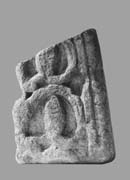
Object type: Cross-shaft fragment
Measurements: H. 25.5 cm (10 in); W. (broken) 18.5 > 15.7 cm (7.3 > 6.2 in); D. 21.5 cm (8.4 in)
Stone type: Pale orange (10YR 8/2) grain supported slightly shelly oolite in a sparry matrix with some hollow ooliths. Ooliths range in size from 0.2 to 0.8 mm. Very sparse shell debris up 5 mm. Cleeve Cloud Member, Birdlip Limestone Formation, Inferior Oolite Group, Middle Jurassic.
Plate numbers in printed volume: Ills. 365-70; Figs. 27E, 34A
Corpus volume reference: Vol 10 p. 225-7
(There may be more views or larger images available for this item. Click on the thumbnail image to view.)
Part of a cross-shaft. Each face of the shaft is edged with an outer cable moulding and a flat inner moulding. The bottom of the stone is flat and is almost certainly the jointing face with the lower part of the cross. The upper part of the stone is broken obliquely. The stone has also been broken along the line of a vertical drilled fixing-hole or dowel-hole 3 to 3.5 cm (1.2 to 1.4 in) in diameter, and face B is missing. A downward sloping hole 2.5 cm (1 in) in diameter has been drilled through face C (see below) to meet the vertical hole. The sloping hole was presumably for pouring lead in and around a metal fixing dowel located in the vertical hole.
A: This incomplete face is dominated by a large, finely-carved, human figure. The figure is frontal. The top part of the head is missing from just above the right ear to below the left ear. The break line actually passes through the right eye and the remains of a drilled pupil are visible. Most of the nose has been lost, but the outline of the right nostril and the right side of the nose survive. The upper lip is well defined, as is the slightly open mouth that turns down at the corners. There is no beard or moustache, but the chin is fairly sharp and the cheeks rounded. Just below the break on the right side of the face, behind part of the figure's ear or hair, there is a slightly raised area with a curving outer edge. The rest of the background is cut back into pronounced vertical ridges. The figure wears a round-necked tunic and an over-garment. The tunic is decorated with pelleting or beading at the neck, and vertical panels at the front. The over-garment is draped across the right shoulder in well-modelled folds. A median-incised fold of the over-garment or a border runs diagonally across the right side of the figure from shoulder to waist. About 6.5 cm below the shoulder, an area of the folds of the over-garment has been flattened by chisel or adze blows. The shoulder itself has been cut by two deep, V-shaped, slightly curving grooves.
B: Missing
C: Decorated with a median-incised tree-scroll, broken along the central vertical stem. Each volute terminates in a upward-pointing veined leaf. Lobed leaves or fruit spring from the junctions between the volutes and the central stem, and overlap each volute just below the leaf terminal.
D: The full width of this face survives. It carries two volutes of a simple, median-incised plant-scroll. Each volute terminates in a veined drop leaf. A similar leaf drops from the outer edge of the upper volute, and part of another drops from the outer edge of the lower volute. From the node between the two volutes grows a bud on a stiff stalk.
The scroll on face D and the tree-scroll on face C are typical of eighth- and early ninth-century carving. Although it is slightly unusual to find leaf forms used as the central terminal of the volutes, the earliest cross-shaft from the St Oswald's group also uses terminal leaves, albeit in a rather more adventurous way (Gloucester St Oswald 1, p. 207, Ills. 265–73). Among other examples are those recorded at Ramsbury and Britford, both in Wiltshire (Kendrick 1938, pls. LXXVI, XCIX; Cramp 2006, 206–7, 231–2, ills. 411–20, 506–7). The lobed leaves and veined leaves are found widely throughout Northumbria, the centre from which many of the new ideas spread during the eighth and ninth centuries. Example can be found at Rothbury, Hexham, Lowther, Bewcastle, Ruthwell, Jedburgh, Lastingham, and elsewhere. More locally these elements occur on the Lechmere Stone (Hanley Castle 1, Ills. 638–41) and on the early ninth-century cross-head from Cropthorne (Ills. 621, 625, 629–33), both in Worcestershire. They do not occur on any of the other Gloucester crosses. The bud on a stiff stalk, that grows from the dividing point of the two volutes on face D of the Tanners' Hall shaft, can be paralleled on Hexham 3 and also from the late eighth- or early ninth-century cross at Simonburn in Northumberland (Cramp 1984, 177–8, pl. 174.924; ibid., 223, pl. 219.1240).
The most unusual aspect of the Tanners' Hall shaft is the human figure of face A. In Gloucester, none of the St Oswald's cross-shafts bear human figures. There is a figure on the London Road cross-shaft (p. 221, Ills. 356, 360), but it is of the highly stylised, late tenth- or early eleventh-century type found, for example at Aycliffe in Co. Durham (Cramp 1984, pls. 7, 8, 11). At Gloucester Cathedral, there is a panel bearing a roundel in the centre of which is a badly damaged figure of Christ (Gloucester Cathedral 1, p. 203, Ills. 252–6). Apart from this, the nearest Anglo-Saxon carvings of similar quality are the full-length figures on the Lypiatt cross-shaft, which stands near the Cotswold village of Bisley, about 10 miles south-east of Gloucester (Bisley Lypiatt 1, p. 143, Ills. 54–63). Not enough survives of the Tanners' Hall figure to assess whether it was full-length or not, but it is at the same scale as the Lypiatt figures which are about 80 cm high. The figures on the crosses from Ruthwell and Bewcastle are similar in height. Half-length figures or 'portrait' busts are fairly widespread in Mercia. Examples include the figure of the Virgin from Breedon-on-the-Hill (Cramp 1977, 210, fig. 58), the Angel from Deerhurst (Deerhurst St Mary 4, p. 168, Ill. 145), the damaged Christ from Gloucester Cathedral, and a figure from Pershore in Worcestershire (Pershore 1, p. 360, Ills. 646–7). However, the treatment of the face on the Tanners' Hall cross-shaft is most similar to that of Christ from the top of the shaft of Rothbury 1, Northumberland (Cramp and Miket 1982, cover and pl. 40a; Cramp 1984, pls. 213–14). The features of the Tanners' Hall figure are rounded and youthful, with a slightly pointed chin and no beard or moustache. The mouth is firm and slightly open. There are traces of the modelling of the lower part of the right eye, and the pupil is drilled.
The curving edge to the carving behind the right ear may indicate that the figure had a small halo, rather tight to the head. However, in most contemporary representations the halo rises from the shoulders and is much larger. The curving edge may, therefore, simply be part of the figure's hair. In this case the figure should probably not be interpreted as Christ, but perhaps as a saint. The Virgin on the Breedon stone does not have a halo. A very worn figure on a cross-shaft from Hackness in eastern Yorkshire also has no halo, and could represent the Abbess Oedilburga (who might be equated with one of the saints by the name of Æthelburh, perhaps the abbess of Lyminge of that name, who was the widow of King Edwin of Northumbria) (Lang 1991, 138–40, ill. 454). This cross has been given a late seventh- to early ninth-century date. On the Bisley Lypiatt 1 cross, the figure on face D has no halo but is interpreted as one of the Evangelists (p. 145). A late eighth-century panel from Breedon, Leicestershire, contains a pair of male figures without haloes, one of whom carries a book in his left hand (Cramp 1977, fig. 55). A late eighth-century date has been suggested for much of the Breedon material (Webster and Backhouse 1991, 239). On the Bewcastle cross, the figure normally identified as John the Baptist has no halo, nor does the figure with a bird who might be St John the Evangelist (Bailey and Cramp 1988, 68–70, ills. 92, 94, 95). At Ruthwell, the figures of Mary and Martha do not have halos, but neither do St Paul and St Anthony (Cassidy 1992, pls. 24, 39).
Several of the figures on the base of the late eighth- or early ninth-century cross-shaft at Aukland St Andrew, Co. Durham, wear garments similar to the Tanners' Hall figure (Cramp 1984, 37–40, pls. 1, 2, 4, 5). However, the closest parallel for the clothes occurs on a portrait of St John Chrysostom that is inserted into an early ninth-century Gospel Book from Salzburg (Hubert et al. 1970, 180). St John, Archbishop of Constantinople from 398 to 404, wears an over-garment, and a tunic that has vertical panels across the front. The over-garment, presumably a chasuble, falls from the shoulders in heavy folds and has a deep, V-shaped opening at the front, bordered by two narrow, parallel bands. This may be intended to indicate the Y-shaped pallium of an archbishop or the pope. The pallium is shown more clearly on a mosaic portrait of Pope Paschal I (817–24) in the apse of Santa Prassede in Rome (Backes and Dölling 1969, 60–1).
On the mosaic mentioned above, Pope Paschal has the square nimbus that denotes a living person. It would be possible to interpret the carved vertical ridges behind the Tanners' Hall figure in a similar way, and to suggest that the figure depicted was a living saint. It is, however, more likely that the carving is intended to indicate curtains or drapes behind the figure. It is equally possible that these deep, rather coarse vertical cuts were not part of the original design. They could have cut away the background, and even, perhaps, removed part of a larger halo. Certainly the curving, V-shaped cuts across the figure's shoulder are later, and make little sense in relation to the folds of the over-garment. The chisel or axe damage to the front of the folds might have occurred after the cross-shaft had been broken up, but the cuts into the shoulder look deliberate. They may have been made to remove something, but the cuts create an oval depression with a raised centre and may equally have been carved to form the seating for something like a shoulder brooch. Perhaps this was intended for the display of an object associated with the saint depicted on the cross-shaft?
The cable moulding that forms the outer border for each face of the cross is wider and flatter than that on Gloucester St Oswald 4 and on the Wotton Pitch shaft (this volume Gloucester London Road 1). It is more like the border on the early ninth-century Lechmere Stone in Worcestershire (Hanley Castle 1, p. 357, Ills. 635–45). It is also similar to the border on the late eight- or early ninth-century cross no. 3 from Hexham (Cramp 1984, pls. 174–5). Part of an early tenth-century arch, reused in a late tenth-century context at St Oswald's, is decorated with oval pelleting and a flat cable. In this last instance, however, the sides of each twist of the cable are concave rather than straight as they are on the Tanners' Hall stone (Gloucester St Oswald 17, p. 217, Ill. 324).
