Select a site alphabetically from the choices shown in the box below. Alternatively, browse sculptural examples using the Forward/Back buttons.
Chapters for this volume, along with copies of original in-text images, are available here.


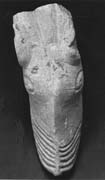
Object type: Animal-head label stop
Measurements: H. 39.6 cm (15.6 in); W. c.15.4 cm (6.1 in); D. of beast head 12.5 cm (4.9 in); of head plus keying block 28.5 cm (11.2 in)
Stone type: Very pale orange (10YR 8/2) oolite with a sparry matrix. It is variably matrix and grain supported. Hollow ooliths common and the oolith size is 0.2 to 0.8 mm. No shell debris was seen. Cleeve Cloud Member, Birdlip Limestone Formation, Inferior Oolite Group, Middle Jurassic.
Plate numbers in printed volume: Ills. 470-2; Fig. 29H
Corpus volume reference: Vol 10 p. 260-1
(There may be more views or larger images available for this item. Click on the thumbnail image to view.)
The head is cut on a curving centre line which may betray the circumference of the arch from which it came. The face is well moulded, with a long, pointed muzzle of triangular cross-section, accentuated by curving U-shaped grooves that sweep up to meet on the nasal ridge. The eyes are elliptical with drilled pupils, and the ears are pointed and laid flat back along each side of the head. The neck muscles may have been carried onto the hood-moulding as a double roll. Three-quarters of the head hung down above the face of the wall, only being keyed at the top. The animal is almost certainly a dog rather than the more common dragon.
Appendix A item (stones dating from Saxo-Norman overlap period or of uncertain date).
When first published by the present author (Bryant 1999, 178–80) the group of animal-head label stops that were found reused in fourteenth-century or later contexts during the excavations at St Oswald's (Gloucester St Oswald 18, 27, 28, 29), were assigned to the first quarter of the twelfth century and linked to the building of the north transept and the rebuilding of the east end of the church. This date may still be correct, as local parallels from St Swithun's, Leonard Stanley (founded 1121–30) or St John the Baptist's, Coln St Aldwyns might suggest. However, further research for this volume has encouraged the present author to suggest that a wider date-range for the St Oswald's animals would be appropriate.
The small animal-head (Gloucester St Oswald 18, p. 218, Ills. 326–9) is closer in style to the animal-head label stops from Deerhurst in Gloucestershire which are dated to the first half of the ninth century (see Deerhurst St Mary 11–14, 16–19, pp. 176–85). St Oswald 18 is also similar to an animal head found during excavations in 1978–9 at St Mary de Lode in Gloucester (Gloucester St Mary de Lode 2, p. 206, Ills. 259–60) which is dated to the mid-ninth century (Bryant and Heighway 2003, 155, fig. 18). Gloucester St Oswald 18 could, therefore belong to the first phase of building at St Oswald's in the tenth century.
The gentle, dog-like face of the larger animal (Gloucester St Oswald 27, Ills. 470–2) is more difficult to place art-historically. Zarnecki dated this carving to 1130–40, and compared it with the label stops in the nave of Malmesbury Abbey in Wiltshire (Zarnecki et al. 1984, 175, cat. 133). The Malmesbury animals are certainly similar and more like dogs than 'dragons', but they are much more ornate. They also sit rather uncomfortably in their present positions in the twelfth-century nave. It seems possible to the present author that the Malmesbury animal heads may have been reused from an earlier structure, although this suggestion is not supported by Robinson and Lea in the most recent work on Malmesbury where the beasts are seen as integral elements of the mid twelfth-century nave (Robinson and Lea 2002, i, 31–5). It is, however, the case with the two, admittedly rather more aggressive, animal-head label-stops reset either side of the west door at Ripple in Worcestershire (Ripple 1 and 2, pp. 361–3, Ills. 648–51; where they are dated to the late tenth or eleventh century). In manuscript art gentle-faced animals are not widely used, but there is one that is very similar to the Gloucester animal on an initial letter on fols. 3r/59r in a late ninth- or early tenth-century manuscript (Cambridge, Corpus Christi College MS 173) probably from Christ Church, Canterbury (Budny 1997, 84, ill. 11). Similar heads occur on the Initial fol. 84 of London, College of Arms, MS Arundel 22, a late tenth-century gospel fragment probably from Winchester (Temple 1976, 54, cat. 26, col. pl. on p. 21), and on fictive capitals in the canon tables from an early eleventh-century Bavarian gospel book from Freising (MS McClean 20, fol. 7v, in Binski and Panayotova 2005, 58).
Not enough survives of the other two stone fragments (Gloucester St Oswald 28 and 29, Ills. 473–4, 475–6; see below) to add materially to any art-historical discussion, but they are clearly parts of a similar animal head to Gloucester St Oswald 27. It is, therefore, not impossible that the large animal-head (no. 27) together with nos. 28 and 29 could, like the smaller example (Gloucester St Oswald 18), belong to the first phase of building at St Oswald's in the tenth century, but, set as they are in the continuing regional use of animal-head label stops, it is difficult to be more precise than tenth to mid-twelfth century.
