Select a site alphabetically from the choices shown in the box below. Alternatively, browse sculptural examples using the Forward/Back buttons.
Chapters for this volume, along with copies of original in-text images, are available here.


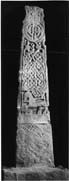
Object type: Shaft and part of head of cross, in three joining pieces, now reassembled
Measurements: H.143.5 cm (56.5 in); W. 38 > 19 cm (15 > 7.5 in); D. 22.8 > 19 cm (9 > 7.5 in)
Stone type: Coarse-grained, massive yellow sandstone
Plate numbers in printed volume: Pls. 9.29-30, 10.31-32
Corpus volume reference: Vol 1 p. 43 - 4
(There may be more views or larger images available for this item. Click on the thumbnail image to view.)
Head, type A11 or D11.
A (broad): The upper arm of the cross-head is filled with traces of a six-cord plait. In the centre of the head is a flat-band moulding enclosing a circular motif, composed of quadrants interlaced with a free ring.
The shaft is plain at the base and edged and divided horizontally into three panels by flat-band mouldings. (i) A complex twelve-cord plait based on pattern A with added diagonals and central pattern F elements. Four of its strands terminate in the necks and ear extensions of two animals. They have bumpy foreheads and open jaws which snap at two small pellets above. Between their heads are two open circles. (ii) A centaur-like creature. It has a horse's body and legs, also a horse-like head, but human arms; its right hand is extended to hold an upright staff. Its left reaches back to hold its tail which is knotted over its back. (iii) Remains of a panel of plain plait.
B (narrow): Inset in a single panel on the shaft is a long, undulating ribbon animal with its tongue and possibly its tail extended and knotted in each body curve in a Stafford Knot. There is a bar behind its head and its two front legs appear from behind it, as if fettered. It has a canine head with long jaws and what is possibly its tail extends over the frame.
C (broad): The short upper arm of the cross-head contains a plain plait. In the centre of the head is a circular quadrant design in which there is a knot in each quadrant, enclosed in a flat-band moulding. The only surviving ornament on the shaft is a composition with two crossed ribbon animals, whose tails divide into strands which interlace with their tongue and ear extensions. The animal heads are basically the same as on face A, but their bodies are flatter and double-outlined.
D (narrow): There is a small panel with two closed circuit loops at the edge of the head. The shaft is divided into two panels by a flat-band moulding. (i) A small panel of step pattern 1. (ii) A panel of five registers of interlace, simple pattern E, terminating below the break in one register of pattern D. At the base is part of a panel of plain plait.
Turbulent interlace such as this, ending in animal heads, is also found at Lindisfarne (no. 7); extended animals also occur with triquetra knots in the curves of their bodies at Tynemouth (no. 4). Likewise undulating animals with double-outlined bodies are found on Chester-le-Street 8. However, there is a good deal of similarity in ornament between this piece and Sockburn 8, where there are ribbon animals (of a more purely Scandinavian type), a panel with a fantastic beast, as well as one with a quadrant pattern (Introduction, p. 29). The small panel of plain plait at the base of faces A and D can be paralleled at Lindisfarne (no. 2) and also on Aycliffe 1. The centaur finds its parallel on Tynemouth 2. The shape, form and ornamentation of the head is unique but it seems to have been influenced by the revived taste for straight line patterns.
