Select a site alphabetically from the choices shown in the box below. Alternatively, browse sculptural examples using the Forward/Back buttons.
Chapters for this volume, along with copies of original in-text images, are available here.


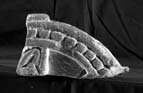
Object type: Part of cross-head
Measurements: H. 14 cm (5.5 in); W. 24 cm (9.5 in); D. 11.5 cm (4.5 in)
Stone type: Pale red (5R 6/2), fine- to coarse-grained (0.2 to 0.6 mm, but mostly medium-grained between 0.4 and 0.5 mm), sub-angular to sub-rounded, clast-supported, quartz sandstone. Chester Pebble Beds Formation?, Sherwood Sandstone Group, Triassic
Plate numbers in printed volume: Ills. 112-14
Corpus volume reference: Vol 9 p. 69
(There may be more views or larger images available for this item. Click on the thumbnail image to view.)
Fragmentary circle-head with one quadrant of the circle connecting a (? vertical upper) arm with fragments of one lateral arm. The protruding lug survives complete on the upper arm but only fragmentarily on the lateral arm.
A (broad): The circle is decorated with bosses set within a roll-moulding border. Only fragments of one lateral border moulding and a Stafford-knot terminal of a knotwork pattern survive on the arm.
B (narrow):The rim of the circle carries a border moulding framing two Stafford knots (simple pattern E) linked by ring-encircled crossing strands.
C (broad): The only decoration visible on this face are bosses set around the circle, framed by border mouldings.
D (narrow): Lost
Circle-head (see Chapter V, p. 31). The bossed decoration of the circle is found again within the group at Bromborough 3, Chester St John 4 and 5, Diserth in north Wales and Gargrave 5 in Yorkshire (Ills. 35, 37, 94, 95, 97; Nash-Williams 1950, no. 185, pl. XXXIII; Coatsworth 2008, ills. 289–90). The fragment of interlace on the arm restores best as a Stafford-knot terminal, a motif which is frequently found within this set. The simple ring-twist terminating in Stafford knots, which is cut neatly on the outside of the circle, is repeated in the same position on Chester St John 4 and 5 (Ills. 92, 96). This head is therefore almost certainly from the Chester St John workshop.
