Select a site alphabetically from the choices shown in the box below. Alternatively, browse sculptural examples using the Forward/Back buttons.
Chapters for this volume, along with copies of original in-text images, are available here.


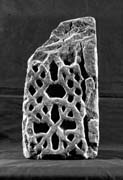
Object type: Fragment of cross-shaft
Measurements: H. 35.5 cm (14 in); W. 19 > 18 cm (7.5 > 7 in); D. 12.5 cm (5 in)
Stone type: Pale brown (5YR 5/2) fine to coarse-grained (0.2 to 0.6 mm, but mostly in the range 0.3 to 0.4 mm (medium-grained); a few grains up to 1.0 mm), angular to sub-angular, clast-supported, quartz sandstone. ?Helsby Sandstone Formation?, Sherwood Sandstone Group, Triassic
Plate numbers in printed volume: Ills. 23-6
Corpus volume reference: Vol 9 p. 51
(There may be more views or larger images available for this item. Click on the thumbnail image to view.)
A (broad): Flanked by a surviving arris border to the right is a fragmentary panel of knotwork. This consists of two diagonalling strands with widely spaced free rings enclosing the crossings; one complete and one partial ring survive. As the strands cross the rings they are themselves bound by figure-of-eight twists (closed-circuit pattern F). The entire composition is worked in flat open strands.
B (narrow) and C (broad): Cut away
D (narrow): The heavily worn face may have carried some form of scroll.
Neat well-spaced knotwork based on closed circuits is not a familiar motif elsewhere in Cheshire, and its specific form here — a simple design which yields a seemingly complex pattern — seems to be unique in the English sculptural corpus. There are however analogous ring-based types in the Peak District area of Derbyshire and at Checkley in Staffordshire which are roughly contemporary and reflect similar tastes (Darley Dale, Norbury, Hope, Checkley: Kendrick 1949, pls. XLIX, L; Routh 1937, pl. XV). In discussing similar patterns — though of an earlier date — at Ramsbury in Wiltshire, Kendrick and Cramp both suggested that the type owed its origin to Mediterranean models (Kendrick 1938, 212; Cramp 2006, 229). The loose ring is a typical feature of Viking-age carving in the north.
