Select a site alphabetically from the choices shown in the box below. Alternatively, browse sculptural examples using the Forward/Back buttons.
Chapters for this volume, along with copies of original in-text images, are available here.


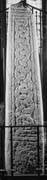
Object type: Cross-shaft with part of -head in two joining pieces [1]
Measurements: H. 167 cm (66 in); W. 36 > 26 cm (14 > 10.25 in); D. 24 > 20 cm (9.5 > 8 in)
Stone type: Yellowish grey (5Y 7/2) with orange staining, poorly sorted, clast-supported, quartz sandstone. The sub-angular to sub-rounded clasts range from fine-grained (0.2 mm) to granular (4.0 mm), but are mostly medium- to coarse-grained in the range 0.4 to 0.8 mm; a few small scattered flakes of white mica. Millstone Grit, Carboniferous
Plate numbers in printed volume: Ills. 653-6
Corpus volume reference: Vol 9 p. 239-40
(There may be more views or larger images available for this item. Click on the thumbnail image to view.)
Each face of the shaft is decorated with a single panel enclosed within a double cable-moulding frame. The lower part of the surviving cross-head is divided from the shaft by a horizontal flat-moulding which runs round all four faces. The lowest 30 cm (12 in) of the shaft have been left undecorated.
A (broad): Decoration consists of crossing strands encircled by rings (closed circuit pattern A) with bar terminals. A box point turn of interlace can be seen in the lower left corner of the head.
B (narrow): The single panel is decorated with a stripped form of spiral scroll, the spiral terminating without fruit or leaf. Between the main stem, spiralling offshoot and the border is a pellet. The main stem of the scroll terminates below in a simple angular curve.
C (broad): Though heavily worn, it is clear that this face carried a single panel; a small part of its interlace decoration survives in the lower left corner and consists of two box point turns with a curving strand between them. The head shows some traces of interlace in the lower right corner.
There are possible traces of a two-line inscription in the undecorated area at the base of the shaft.
D (narrow): The sole shaft panel carries a single-stemmed trail with alternating pendant leaves; the leaves have extended curled tips with, below, a plain oval leaf set on a short stalk; at the bottom of the scroll there are two oval leaves set just below the curled-tip forms. Between the leaves, stem and border is a pellet. The stem terminates in a curled leaf, with round bud, which curves round at the top of the frame. No decoration is visible on the concave curve of the surviving fragment of head.
Though comparatively simple in its decoration, this cross was an impressive and well-executed monument. Its impact would have been further enhanced by the fact that the stone from which it is carved is not native to the area, having been brought at least 43 miles (70 km) south-westwards (Chapter III, p. 17). Like Accrington 1 it combines full-length panels, including Anglian-derived scrolls, with cabled borders (Ills. 392–5). The use of a ring-encircled simple plait points to a Viking-period date. Whilst the curled-tip leaf forms, with pendant leaf at their base, are close to types seen in the tenth/eleventh-century manuscripts, the motif was well established much earlier in eighth- and ninth-century art (e.g. Webster and Backhouse 1991, nos. 170, 187, 237).
The stripped scroll with pellets placed between the curls may be a reflection of metallic rivets, but is probably a further regularising of a system of border pellets seen on Lancaster St Mary 3 in the pre-Viking period (Ills. 579–80).
