Select a site alphabetically from the choices shown in the box below. Alternatively, browse sculptural examples using the Forward/Back buttons.
Chapters for this volume, along with copies of original in-text images, are available here.


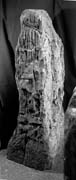
Object type: (4) Part of shaft [1][2]
Measurements: H. 120 cm (47.25); W. 37 > 31 cm (14.5 > 13.25 in); D. 37 > 30 cm (14.5 > 11.75 in)
Stone type: As Sandbach (St Mary) 1 above, but noticeably thinly bedded (bedding vertical)
Plate numbers in printed volume: Ills. 297-300
Corpus volume reference: Vol 9 p. 123
(There may be more views or larger images available for this item. Click on the thumbnail image to view.)
A (west): Only one panel is now visible; the carving above and below has been lost. Set within an arched niche with plain lateral moulding borders is a forward-facing figure with a knee-length kirtle which droops at the corners.
B (south): At the top of this face there are the remains of relief carving set in an arched panel. This worn carving can be resolved into a forward-facing figure dressed in a skirt with drooping corners. The figure was either winged or carried rods across the shoulders.
C (east): There are the possible remains of the crown of an arched panel at the top of the stone; no other original carving remains on this face.
D (north): The upper part of this face carries an arched panel containing the remains of a figure, wearing a belted kirtle which droops at the corners, and with feet facing to the right. The figure has rounded shoulders and faces to the left with an arm bent across the waist.
See Sandbach (St Mary) 1 above. All of the visible features can be found on the Sandbach Market Square shafts: arched panels, forward-facing winged figures whose garments have drooping corners, forward-facing figures with rods, figures with head in profile and arms bent across the breast. Like Sandbach (St Mary) 1, however, the detail is here less ambitious than on the main Market Square shafts.
[1] Numbers in bracketed italics are those given by Radford (1957) and Hawkes (2002), and used in the present display.
[2] The following is a general reference to the Sandbach St Mary stones: Higham, N. 1993b, 167–9.
