Select a site alphabetically from the choices shown in the box below. Alternatively, browse sculptural examples using the Forward/Back buttons.
Chapters for this volume, along with copies of original in-text images, are available here.


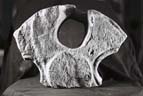
Object type: Fragmentary cross-head [1]
Measurements: H. 44 cm (17.5 in); W. 38 cm (15 in); D. 14 cm (5.5 in); of ring 5 cm (2 in)
Stone type: Yellowish grey (5Y 7/2), poorly sorted, clast-supported, quartz sandstone. The sub-angular to sub-rounded clasts range from medium-grained (0.3 mm) to granular (2.5 mm), but are mostly medium- to coarse-grained in the range 0.4 to 0.8 mm; scattered flakes of white mica. Bedded at a slight angle to the front face. Millstone Grit, Carboniferous
Plate numbers in printed volume: Ills. 413-4, 417-8
Corpus volume reference: Vol 9 p. 166
(There may be more views or larger images available for this item. Click on the thumbnail image to view.)
Ring-head of type E8 with expanded terminals
A (broad): Traces remain of a border to both surviving arms; this is defined by an incised line. The only other decoration is a large (18 cm radius) central boss.
B and D (narrow): No decoration
C broad): As face A but with the central boss (16 cm radius) much abraded.
The presence of a ring indicates that the carving belonged to the Viking period (Bailey 1980, 70–1). As exemplified by Bolton le Moors 1 above, 'penannular', or 'fan-shaped', heads are popular in free-armed form in the southern part of the western Pennines (see Chapter V, p. 33). In combination with a ring they recur further south at Alderley Edge 1, Disley Lyme Hall 1 and 2, and Monyash in Derbyshire (Ills. 9–12, 128–32, 137–8, 139–41, 148–54; Myers and Barnatt 1984). Heads with a large central boss are very common in the area (see Aughton 1, p. 163).
