Select a site alphabetically from the choices shown in the box below. Alternatively, browse sculptural examples using the Forward/Back buttons.
Chapters for this volume, along with copies of original in-text images, are available here.


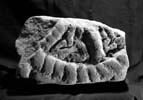
Object type: Part of cross-head [1]
Measurements: H. 23 cm (9 in); W. 38 cm (15 in); D. 14.5 cm (5.75 in)
Stone type: Pale red (5R 6/2), fine- to coarse-grained (0.2 to 0.6 mm, but mostly medium-grained between 0.4 and 0.5 mm), sub-angular to sub-rounded, clast-supported, quartz sandstone. A few scattered sub-angular to rounded, black pebbles 0.3 to 0.6 mm across. Chester Pebble Beds Formation?, Sherwood Sandstone Group, Triassic
Plate numbers in printed volume: Ills. 214-17
Corpus volume reference: Vol 9 p. 89-90
(There may be more views or larger images available for this item. Click on the thumbnail image to view.)
The curving cable moulding forming the border between shaft and head survives on both broad faces. The spandrels are unpierced.
A (broad): Nothing survives of the shaft ornament apart from a fragment of the border moulding. Above are two inward-curving mouldings, both cabled, which form the edges of the lower cross-arm; they enclose a triquetra with pointed turn. To the right are traces of interlace which Cox represented as a further triquetra (Allen 1895, 170).
B (narrow): Possible traces of a step pattern on the shaft
C (broad): Similar to face A, though with no trace of decoration outside the curving borders of the arm. Traces of both cable-moulding borders survive on the shaft.
D (narrow): Within cable-moulding borders there are the remains of an openwork two-strand interlace pattern.
White's drawing confirms my own view that the cabled border of the arm on face A does not over-run the boundary between shaft and head as suggested by the illustration published by Allen (1895, 170; White, R. 1986, fig. 2). The fragment is most closely related to the circle-head Neston 2, sharing with it the step pattern and (probably) ring-encircled twist on the edge of the shaft (Ills. 200–3). Similarly the boundary between shaft and head, together with the arms, are all marked on both crosses by a cabled moulding. This suggests that the Neston 5 fragment displays the ornamental repertoire of a circle-headed cross with unpierced spandrels — and is thus related to the group centred on Chester St John. However, whilst the use of a triquetra in the arms is frequently employed within that group, nowhere else within that set is the spandrel apparently filled with further interlacing motifs.
