Select a site alphabetically from the choices shown in the box below. Alternatively, browse sculptural examples using the Forward/Back buttons.
Chapters for this volume, along with copies of original in-text images, are available here.


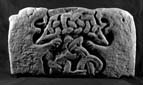
Object type: Incomplete hogback
Measurements: L. 48.5 > 47.5 cm (19.25 > 18.75 in); W. at base 12 < 15 > 13.5 cm (4.75 < 6 > 5.5 in); at crown 11 cm (4.25 in); H. at crown 27 cm (10.5 in)
Stone type: Pale yellowish brown (10YR 6/2) fine- to coarse-grained (0.2 to 1.0 mm, but mostly in the range 0.4 to 0.6 mm), sub-angular to sub-rounded, clast-supported, quartz sandstone. There are a few scattered quartzite pebbles up to 1.25 cm across. Delamere Pebbly Sandstone Member, Helsby Sandstone Formation, Sherwood Sandstone Group, Triassic
Plate numbers in printed volume: Ills. 27-33
Corpus volume reference: Vol 9 p. 49-51
(There may be more views or larger images available for this item. Click on the thumbnail image to view.)
On both broad faces the decoration is flanked by large end-beasts whose backs slope inwards towards the base of the stone. The base is slightly bombé in plan and the ridge-line between the beasts is curved.
A (long): The two end-beasts have open jaws with tongues and a single front paw. Both jaws (and possibly also parts of the body) are outlined and each has a large upper tooth. The beast on the left has a single bulbous almond-shaped eye and an extended ear, whilst the other animal now lacks both eye and most of its ear; the seeming hole-like 'eye on this right-hand beast is caused by the loss of a quartz pebble or clast. The upper jaws of both animals meet the curving ridge-line of the stone. Each beast has a single extended paw; to the right this ends in four toes and to the left in three. Beneath the neck of the left-hand beast the body carries a simple two-strand twist, set vertically and carved in low relief; there are traces of similar ornament on the right-hand animal. In the panel bounded by the ridge, open jaws and paws, there is a curving run of knotwork formed by two strands; one of these emerges from the tongue of the beast to the right and returns to join its lower jaw. Below this run of horizontal interlace, and set between the paws and lower bodies of the flanking animals, are three (now incomplete) inter-linked Stafford knots (simple pattern E) formed by median-incised strands.
B (end): Possible traces of a narrow vertical panel with arched head containing knotwork.
C (long): The decoration is badly damaged but sufficient remains to indicate that both end-beasts had open jaws with a single upper tooth and protruding tongue similar to those on the other main face; the visible forelegs both appear to have three toes. There is the strong possibility that the right-hand beast had a hind leg extending along the bottom of the carving. As on face A, the upper part of the stone was decorated by a curving run of knotwork, with pointed extensions to the turns in the lower corners. The lower decoration is now difficult to interpret but seems to have consisted of a central-stemmed bush scroll terminating at the top in two large leaf or fruit forms, one rounded, the other oval in shape. To the right of the stem are forms which might be resolved into a long-necked bushy-tailed animal, seen in profile, whose head is set against the oval leaf; a single paw extends towards the base of the bush vine. It is, however, equally possible to interpret these relief shapes as further side-shoots of the scroll. There are similar problems in identifying the ornament to the left of the bush. In certain lights it appears to consist of an animal, with marked haunch and pointed head, biting towards the scroll; the curving form across its body may be part of a side shoot of the scroll or another, serpentine, animal. Alternatively all of the relief forms on this side may represent extended side-shoots of the scroll terminating in large leaves.
D (end): Possible traces of a panel of knotwork towards the base of the stone
There is no doubt that this is a hogback, a Viking-age form of recumbent monument whose distribution through Cumbria and Yorkshire points to an association with Hiberno-Norse groups in northern England (see Chapter V, p. 38). The substantial three-dimensional end-beasts, curving ridge-line and bombé ground plan are all characteristic features of this class of sculpture, which dates to the first half of the tenth century. What is not typical are the dimensions of the carving. 34 of the 119 known hogbacks survive in sufficiently complete state to allow comparative measurement. (This total is based on the material in: Cramp 1984; Bailey and Cramp 1988; Lang 1984; id. 1991; id. 2001.) On this evidence the average length of English hogbacks is 142.4 cm, and the vast majority, indeed, are over 120 cm long and thus of a size appropriate to covering a grave. Apart from Bidston, only three are less than 90 cm in length. These are: Kirkby Stephen 8 (80.6 cm), Ingleby Arncliffe 3 (76.4 cm) and Brompton 16 (76 cm) (Bailey and Cramp 1988, 125; Lang 2001, 73–4, 125–6). Bidston, at 47.5 cm, is thus by some margin the smallest known hogback. Given its diminutive form it is clear that this stone can never have acted as a grave-cover — though it has to be admitted that the evidence for that role for any hogback is decidedly thin (see Heysham 5, p. 201). If, as is likely, it did have a funerary function then it must have served as a grave-marker, or perhaps even as a head-stone in a composite monument similar to the beast-dominated end-stones (nos. 32 and 33) associated with burial 51 in the York Minster cemetery (Lang 1991, 70–1, ills. 133–40; id. 1995, 442, 456–7, pls. 130–1). A grave-marker could, of course, have been placed centrally over the grave (Everson and Stocker 1999, 209, ill. 263).
In many ways the Bidston sculpture is an innovative and ambitious monument. Its plant ornament and linked Stafford knots, for example, are unique across the hogback corpus; it is one of the few such monuments to have decoration on the narrow ends — and is unique in applying these to the broad backs of end-beasts. It is also the only hogback to add further low-relief carving to the bodies of those beasts, though this penchant for additional body decoration may reflect local Viking-age tastes because an animal on Prestbury 1 is similarly treated (Ill. 237). Unique also is the manner in which the beasts' paws and body define a panel of ornament on the lower half of the stone.
Both the scroll ornament and the linked Stafford knots can plausibly be interpreted as Christian symbols. Animals flanking, and eating from, a scroll represent a version of the much-studied theme of the Tree of Life, a multi-valent symbol both of God's bounty and generosity, and of Christ's sacrifice and its Eucharistic re-enactment (O'Reilly 1992). It is, admittedly, more difficult to demonstrate that the decoration of three inter-linked Stafford knots arranged in a triangle on the lower part of face A carries significance beyond the purely ornamental. The ornament can, however, be read as three linked triquetra — a motif which was used as a symbol of the Trinity in medieval art (see discussion under Winwick 1 below, p. 257).
All four hogbacks sites in Lancashire and Cheshire are geographically isolated from the main centres of production of this type of carving in Yorkshire and Cumbria (see Chapter V, pp. 38–9). All, however, are significantly close to accessible harbours or beaches, Bidston lying within a mile of the well-known beach market at Meols (Griffiths 1992, 66–9; id. 1996, 56; id. 2001b; Griffiths et al. 2007). Building on this observation, I have argued that this diminutive carving represents the memorial of a Meols trader, probably operating on the Dublin–Chester–York route, whose allegiance to his Yorkshire roots is expressed in the ornament and decorative organisation of the stone (Bailey and Whalley 2006). This case is summarised below.
Despite its novelties, the general decorative organisation reflects the group of hogbacks labelled by Lang as the 'extended niche' type (Lang 1984, 99; id. 2001, 21–4). This is not a type known in Cumbria; its development and concentration lies in northern Yorkshire and particularly at Brompton, near Northallerton, where there are four examples, including one of the miniature hogbacks mentioned above (Lang 2001, ills. 79–81, 92–3, 101–3). In this group the 'roof' area of the building-shaped stone is occupied, not by the usual tegulation, but by a run of horizontal knotwork set between the heads of two substantial end-beasts whose backs slope inwards towards the base. Below the knotwork is an arched niche flanked by the lower part of the animals. Given the possibility that Bidston's animals each had two sets of paws, it is worth noting also Lang's observation that, in this 'extended niche' group, the end-beasts are often given hind legs (Lang 1984, 106). Bidston has the knotwork run and substantial, probably four-legged, beasts of the Yorkshire group; its innovation is to define the 'niche' by the animals' paws and to fill it with decoration.
Bidston's links are thus with northern Yorkshire, Brompton providing the best set of parallels for the combination of substantial end-beasts and general ornamental lay-out. There are admittedly three additional details in which the Cheshire carving differs from any now surviving at Brompton. First the animal's leg is placed below the interlace rather than being set against the ends of the knotwork; secondly the beasts' jaws encompass the entire height of the interlace; and thirdly the beast is linked to the knotwork through its tongue. All of these details however are present elsewhere on Yorkshire hogbacks. Lang, for example, has published a very worn fragment from St Mary Bishophill Senior in York, with end-beast and horizontal interlace run, which has legs and jaw in precisely the Bidston positions (Lang 1991, 93, ills. 285–6; for the suggestion that St Mary Bishophill was patronised by a Hiberno-Norse trading community, see Stocker 2000, 204). And there is an analogous treatment for the joining of beast and knotwork at Barmston in eastern Yorkshire where the interlace terminates in the jowl of the animal (Lang 1991, 125, ill. 423). All this suggests that Bidston's sculptor was familiar with the decorative tastes, and monument preferences, of tenth-century north Yorkshire and that his memorial asserts an identity with the secular trading elite of that eastern region.
