Select a site alphabetically from the choices shown in the box below. Alternatively, browse sculptural examples using the Forward/Back buttons.
Chapters for this volume, along with copies of original in-text images, are available here.


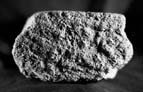
Object type: Part of cross-arm
Measurements: H. 15 > 11 cm (4.25 > 5.9 in); W. 22.5 cm (8.75 in); D. 11 cm (4.25 in)
Stone type: Pale yellowish brown (10YR 6/2), clast-supported, quartz sandstone. The sub-angular to sub-rounded clasts range from 0.3 to 5.0 mm, but are mostly coarse-grained in the range 0.6 to 1.0 mm; some white feldspar clasts. Millstone Grit, Carboniferous
Plate numbers in printed volume: Ills. 618-22
Corpus volume reference: Vol 9 p. 233
(There may be more views or larger images available for this item. Click on the thumbnail image to view.)
Cross-arm from head of type B9. Only the two broad faces carry decoration and both have a roll-moulding border.
A (broad): A central moulding terminates towards the end of the arm in a swollen terminal with a scooped centre. Around this spine moulding is an irregular zigzag form.
C (broad): A central moulding terminates in a half-round terminal. This is surrounded by bosses.
Forms of cross-head with zigzags surrounding a 'spine-and-boss' ornament are discussed under Heysham 3 (p. 200, Ill. 513; see also Chapter IV, pp. 20, 25). The combination here, with a reverse where bosses surround the same form of ornament, is found again at Northallerton (Lang 2001, ills. 672–3) and may also have occurred on a fragment from Ripon (Coatsworth 2008, ill. 650). Bossed ornament reflects the same metalwork background as the zigzags; compare such well-known pieces as the St Cuthbert cross, Ormside bowl, Rupertus cross, and the local Faddiley cross (Webster and Backhouse 1991, nos. 98, 133, 134; Newman and Brennand 2007, fig. 4.7). The drilled hole in the terminal boss may have held a jewel or piece of glass (Ill. 619).
