Select a site alphabetically from the choices shown in the box below. Alternatively, browse sculptural examples using the Forward/Back buttons.
Chapters for this volume, along with copies of original in-text images, are available here.


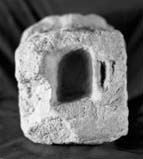
Object type: Fragment of shaft
Measurements: H. 23 cm (9 in); W. 17 cm (6.75 in); D. 16.5 cm (6.5 in)
Stone type: Pale red (10R 6/2), poorly sorted, clast-supported, quartz sandstone. The sub-angular to sub-rounded clasts range from 0.2 to 1.5 mm, but are mostly in the range 0.3 to 0.7 mm; a few scattered pebbles up to 6.0 mm. Millstone Grit, Carboniferous
Plate numbers in printed volume: Ills. 611-4
Corpus volume reference: Vol 9 p. 232
(There may be more views or larger images available for this item. Click on the thumbnail image to view.)
The stone formed part of a shaft and carries a mortise hole for attachment to a head or further section of shaft.
A (broad): Within lateral double roll-moulding borders is knotwork decoration. At the top, adjacent to the mortise hole, is a ring-encircled two-strand plait with pellets. Above are the remains of the continuation of the two-strand plait which, to judge by the surviving decoration, terminated in a Stafford knot. Below, the two-strand plait is laced with a double ring.
B (narrow): A double lateral roll-moulding border survives to the left alongside traces of knotwork.
C (broad) and D (narrow): Lost
E (top): Mortise hole. This measures 9 x 6.8 cm (3.5 x 2.75 in).
Like Lancaster St Mary 6 (Ill. 587), this was a composite monument. The decoration is well spaced and orderly. The loose ring is indicative of a Viking-period date and so too is the use of pellets. Though pellets disposed regularly within interlace are not common they do occur elsewhere in combination with free rings at Two Dales in Derbyshire in a Viking-age context (Routh 1937, pl. XIX). At a similar date they are also used at Checkley in Staffordshire and Osmotherley 2 in Yorkshire as well as Beckermet St John 4 in Cumberland (Lang 2001, ill. 722; Bailey and Cramp 1988, ill. 68).
