Select a site alphabetically from the choices shown in the box below. Alternatively, browse sculptural examples using the Forward/Back buttons.
Chapters for this volume, along with copies of original in-text images, are available here.


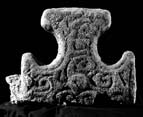
Object type: Incomplete cross-head [1]
Measurements: H. 35 cm (13.8 in); W. 37 cm (14.5 in); D. 15.2 > 13.5 cm (6 > 5.3 in)
Stone type: Sandstone, brown (stained), medium to coarse grained, quartz with some feldspar, quartz cemented. Occasional granule-sized quartz grains. Upper Carboniferous, local Millstone Grit Group. [G.L.]
Plate numbers in printed volume: Ills. 285-8
Corpus volume reference: Vol 8 p. 157
(There may be more views or larger images available for this item. Click on the thumbnail image to view.)
A free-armed cross-head of type A10, of which the upper and side arms survive. The head is edged on both broad faces with a flat moulding. The cutting is shallow.
A (broad): The face appears to be filled with irregular scrolls and curves, not apparently connected by a linking stem, although strands ending in curls spread into and are shaped to the ends of the side arms. Several of the curls seem to spin out from the central boss, which is either plain and damaged, or is itself a rather lumpy curl. It is not the ringed boss drawn by Collingwood.
B and D (narrow): Plain
C (broad): This face is much more severely damaged, but there is a tight spiral or double ring in the left arm, and another similar to the left of the damaged centre.
This cross-head seems to be attempting to emulate Anglian cross-heads with plant-scroll, but the pronounced widening of the arm-ends and the loose disconnected scrolls suggest a later date. The scroll is rather reminiscent of Bailey's 'spiral-scroll school' in Cumbria (Bailey and Cramp 1988, 33-8). There this is seen to have a limited geographical distribution on the coastal plain between the rivers Ellen and Irt, but the one exception, at Addingham in the Eden valley, shows one possible route by which the influence of the style could have spread. Gargrave is on a branch of the Roman road (an extension from Margary 1967, no. 72), a road which may have continued further north and west originally, while Margary 72 itself heads towards the west coast. The background to the characteristic features of the 'spiral-scroll school' are all Anglian but the associated head types are all of Viking-age date.
