Select a site alphabetically from the choices shown in the box below. Alternatively, browse sculptural examples using the Forward/Back buttons.
Chapters for this volume, along with copies of original in-text images, are available here.


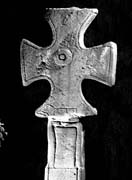
Object type: Top of cross-shaft, or part of -arm [1]
Measurements: H. 35.5 cm (14 in); W. 23 cm (9 in); D. 17.8 > 10.1 cm (7 > 4 in)
Stone type: As Cawthorne (All Saints) 2
Plate numbers in printed volume: Ills. 139–41
Corpus volume reference: Vol 8 p. 116
(There may be more views or larger images available for this item. Click on the thumbnail image to view.)
The piece has a pronounced narrowing most noticeable on face C, which could suggest it is the end of a cross-arm of type B or D rather than the top of a cross-shaft.
A (broad): A double or triple moulding at the top and double roll mouldings at the sides. The inside of the face seems to have partly flaked away. Collingwood (1915a, 153, fig. c) shows this face with a chain of incised linking circles and semi-circles: only traces of what might be the edge of this pattern or an incised twist survive on the left.
B (narrow): There is now no trace of the delicate incised key pattern drawn by Collingwood (1915a, 153, fig. d).
C (broad): An incised outline at the top and sides, otherwise the face is quite plain.
D (narrow): As face C
Ryder (1982, 105) thought this was too small to be part of a cross-head, and suggested that the asymmetry noted above was probably a product of the original stone, with the panel borders following an irregularity. The restorers have had to create a very long tapering insertion in order to fit it between the remaining shaft Cawthorne 4 and the cross-head Cawthorne 2, however. I think it more likely this was a cross-arm, misinterpreted as the top of a tapering shaft by those who reconstructed the cross. Collingwood certainly doubted that it was part of same shaft as Cawthorne 4, but the fine incised work he recorded cannot now be seen. It has similar borders to Cawthorne 2 and 4, but if part of a cross-head implies one of very different form. Its mouldings and slight evidence of incised pattern are, however, not inconsistent with the other pieces from this site.
