Select a site alphabetically from the choices shown in the box below. Alternatively, browse sculptural examples using the Forward/Back buttons.
Chapters for this volume, along with copies of original in-text images, are available here.


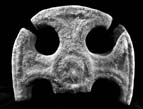
Object type: Incomplete cross-head [1]
Measurements: H. 44 cm (17.3 in); W. 63 cm (24.8 in); D. 15.2 cm (6 in)
Stone type: Coarse grained Millstone Grit, feldspathic with some mica present. Occasional quartzite pebbles ( > 12mm in dimension) also seen. Colour very pale brown (10YR 7/4). Stone provenance as Burnsall (St Wilfrid) 1a–d. [J.S.]
Plate numbers in printed volume: Ills. 105-8
Corpus volume reference: Vol 8 p. 111
(There may be more views or larger images available for this item. Click on the thumbnail image to view.)
An incomplete free-armed cross-head of type E11.
A (broad): The head is edged by a shallow and narrow raised flat moulding, now very worn. The face of the cross is completely plain except for the centre which is slightly domed and filled by a raised equal-armed cross, possibly type A3, although the expanded arms are more curved than Collingwood drew them, and it is possible that a plain Latin cross was surrounded by a complete circle originally.
B and D (narrow): Plain
C (broad): This face needs to be seen in a good light, but it is clear that there is a raised central circle, filling the crossing, from which outline arms of type E10 extend into the upper and side arms. There is a raised cross, with a slight depression in the centre, inside the central circle.
This is a free-armed head, but influenced by the Scandinavian ring-head. Collingwood (1927, 88, figs. 106–8) noted the West Riding development of the fan-shaped head, which he saw as a development from the Anglian elaboration of the end of the arm, citing an example from Dewsbury (no. 12, Ill. 225–6) to illustrate the early stages of the development, Kirkby Wharfe 1 and 3 (Ills. 432–4, 440–2) as exemplifying the 'Anglian tradition not very far gone in decay', and this head (which he believed to be the head of the shaft Burnsall 6) to represent the fully Scandinavianised type which he placed as late as c. 1000 or beyond. But the strongest period of Scandinavian influence must surely be earlier than this, and it need not be far removed from the Kirkby Wharfe examples. There are other examples of particularly exaggerated forms at this site, and Burnsall (St Wilfrid) 7 seems only a small exaggeration of the head types of Burnsall 1, 2 and 5. The connections of this form all seem to be within the West Riding, but unusually both north and south of that area: see examples from Dewsbury, no. 13 (though the reconstruction of this is doubtful), Kirkby Wharfe 1 and 3, Collingham 5, Saxton 1, Staveley 1, and High Hoyland 3, with one outlier at Sherburn in the East Riding (Lang 1991, 205, no. 7, ills. 781–4).
