Select a site alphabetically from the choices shown in the box below. Alternatively, browse sculptural examples using the Forward/Back buttons.
Chapters for this volume, along with copies of original in-text images, are available here.


Object type: Part of shaft
Measurements: H. 59 cm (23.2 in); W. 43 > 36 cm (17 > 14.2 in); D. max. 22 cm (8.6 in)
Stone type: Not seen by geologist: 'millstone grit' (Collingwood 1915a, 239)
Plate numbers in printed volume: Ills. 696-9
Corpus volume reference: Vol 8 p. 249
(There may be more views or larger images available for this item. Click on the thumbnail image to view.)
A fragment of a tapering shaft of possibly rectangular section, although it is not complete in depth.
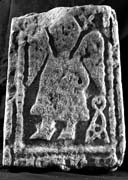
A (broad): The face has battered but probably rounded angles, within which is an inner cable moulding still clearly distinguishable especially on the sides. The remaining face is dominated by a dumpy round-shouldered winged angel with an egg-shaped head and a robe ending just above his feet, which are shod in a type of boot with pointed flaps which, as Collingwood noted, is also seen on some Scottish monuments. The angel's arms appear to be held in front of him, and he may be carrying the cross of type B1 which appears above his left shoulder. Below and to his right, the remaining space is filled by two strands which terminate in curls at the top, cross, and form a Stafford Knot (simple pattern E) in the bottom corner.
B (narrow): There is no trace of carving on this face, which appears to have been set in plaster or concrete at some stage.
C (broad): Hacked away
D (narrow): This appears to have been dressed plain.
Bailey (1980, 232–3) concurred with Collingwood in the similarity of the shoes or boots worn by the angel to those worn by ecclesiastics on a stone from St Vigeans, Angus, Scotland (Harbison 1992, III, fig. 957; Foster 1996, ill. 63), but also pointed out that the same pointed flaps occur on shoes worn by a figure on the ninth-century Abingdon sword (Backhouse et al. 1984, 34, cat. 14), and so may simply have been a common type of shoe. The cabled moulding and angel figure suggests a site with ecclesiastical connections, and this shaft is in the Anglian tradition of panelled figure sculpture, but late in the pre-Scandinavian series.
