Select a site alphabetically from the choices shown in the box below. Alternatively, browse sculptural examples using the Forward/Back buttons.
Chapters for this volume, along with copies of original in-text images, are available here.


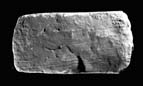
Object type: Centre and one arm of cross-head
Measurements: H. (max. at centre) 25.3 cm (10 in); W. 26.8 cm (10.5 in); D. 14 > 12 cm (5.5 > 4.75 in)
Stone type: Fine-grained cellular dolomitic limestone. Colour very pale brown (10YR 7/3). Cross-head broken but not burnt. Brotherton Formation (Upper Magnesian Limestone), Upper Permian, obtained locally. [J.S.]
Plate numbers in printed volume: Ills. 687-91
Corpus volume reference: Vol 8 p. 245-6
(There may be more views or larger images available for this item. Click on the thumbnail image to view.)
A free-armed cross-head of type E10. Both faces are edged by a narrow flat moulding.
A (broad): At the centre of the head are two loose pellets, one above the other. These are framed by double strands which cross at right angles on either side of the centre. Those to left and right continue towards the side arms and enclose further loose pellets, of which three on the left and one on the right survive. The horizontal strands also continue towards the upper and lower arms. There is one large pellet between those below. Above, in the complete arm, the strands bifurcate and join to form a bar enclosing a horizontal row of three small pellets, and above a single large pellet, before progressing to the end of the arm where they terminate in a Stafford Knot (simple pattern E).
B and D (narrow): The sides of the upper arm and the remaining armpits are dressed plain.
C (broad): This face also has fine double strands. The centre is enclosed by a large, double-stranded ring. There is a similar, smaller, loose ring in the centre of the surviving arm. Double strands appear to follow the curve of the armpits, as if from the side arms, into the upper and lower arms: in the upper arm they cross in the centre of the ring before terminating in a bar at the end of the arm. An almost plant-like tendril springs from the inner strand of the terminating bar to fill the space between it and the ring. A second pair of double strands, from the side arms, cross in the centre of the central loose ring.
E (top): Plain
The angular interlace crossing at a right-angle on either side of the centre is found on five cross-heads in England, all in the West Riding — Aberford 1, Collingham 5, Kirkby Wharfe 1 and 3, and here at Saxton. The pattern shows some influence from designs otherwise found on the Isle of Man, but perhaps even more, some influence from local traditions (see Chap. V, p. 49).
