Select a site alphabetically from the choices shown in the box below. Alternatively, browse sculptural examples using the Forward/Back buttons.
Chapters for this volume, along with copies of original in-text images, are available here.


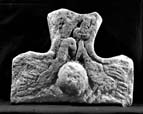
Object type: Incomplete cross-head [1]
Measurements: H. 39 cm (15.3 in); W. 48.2 cm (19 in); D. 14 cm (5.5 in)
Stone type: Not seen by geologist: 'millstone grit' (Collingwood 1915a, 235)
Plate numbers in printed volume: Ills. 655-9
Corpus volume reference: Vol 8 p. 235-6
(There may be more views or larger images available for this item. Click on the thumbnail image to view.)
The upper and most of the side arms of a cross-head of type B10.
A (broad): Two birds face each other on either side and over a central raised boss. The birds stand out proud from the background. That on the left has a drilled eye. Both have wing and tail feathers indicated by incised, curving, parallel lines and some pecking. In the upper arm above the birds is, on the right, an irregular interlaced knot, and on the left, an undetermined feature: it could be the end of a long narrow loop or part of a double-stranded feature. Collingwood considered that the raised boss might also have had interlace, and this is possible, although what it was, is by no means clear.
B (narrow): The armpit is dressed smooth. On the flat end of the side arm is a double-stranded twist, incorporating one loose ring and perhaps a second in the broken lower portion. There is a bar terminal at the top.
C (broad): This face has a flat, probably damaged, central boss, and the arms are filled with a double-stranded irregular twist incorporating loose rings, in both arms and probably, in distorted form, at the top.
D (narrow): Similar to face B, with one and part of a second loose ring incorporated in a double-stranded twist with a bar terminal at the bottom.
E (top): The upper faces of the arms are plain. The top of the upper arm is damaged.
There are two parallels to the paired facing birds flanking a cross, both from north Yorkshire. The earliest, Wensley 8 (Lang 2001, 224–7, ills. 883, 885), is an inscribed slab of eighth/ninth-century date on which a cross of type B9 is flanked by quadrupeds below and birds above. The second, Catterick 1, much more finely carved than the Ripon example, is a cross-head of a similar overall form (type A10), which is very similar in the disposition of its surviving ornament (ibid., 80–1, ills. 111–15). There, however, the paired birds are contained within the lateral arms of the cross, although similarly flanking the central boss. Lang was not convinced that the birds have any particular significance, but interestingly suggested that the Ripon cross is a copy of that from Catterick. The paired birds with their displayed tails may be peacocks, symbols of resurrection, as Bailey suggested (1996a, 80). As such, they appear on early medieval sarcophagi in Italy, for example on a panel from the sarcophagus of Theodota (c. 720) in the Museo Civica, Pavia (Kitzinger 1936, pl. IB). Birds (including peacocks but also other species) and animals facing over a cross also appear in scenes of the Fountain of Life, representing Christ and possibly associated with a baptistery. In spite of these early antecedents, and though combined with the free-armed head, the heavy median-incised strands and the loose rings secured by a twist rather than regular interlace suggest a date in the period of Scandinavian influence. It is similar in overall form and size to the cross-head Ripon 4.
