Select a site alphabetically from the choices shown in the box below. Alternatively, browse sculptural examples using the Forward/Back buttons.
Chapters for this volume, along with copies of original in-text images, are available here.


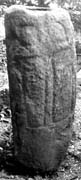
Object type: Cross-base [1]
Measurements: H. 90 cm (35.5 in); W. 52 > 38 cm (20.5 > 15 in); D. 31 > 27 cm (12 > 10.5 in)
Stone type: This is a cross-bedded sandstone from the Carboniferous, a boulder of glacial origin recut with a mortise hole to accommodate a large cross-shaft. [J.S.]
Plate numbers in printed volume: Ills. 618-9, 623-5
Corpus volume reference: Vol 8 p. 227-8
(There may be more views or larger images available for this item. Click on the thumbnail image to view.)
This is an oddly shaped piece for a cross-base. It is like a half-barrel, widest in the middle and tapering at both ends. The geology suggests it is a boulder used because of its shape. An initial assumption, when the back was invisible, was that the flat back implied this base was meant to be seen from one side only, and held a cross-shaft which stood against a wall. As the back is decorated exactly like the front, however, this was clearly not the case. But the layout of the decoration implies it was always meant to be an upright monument.
A (broad) and B and D (narrow): The curved face of the piece seems to have been intended to be seen from the front. It comprises eight panels with incised frames which fill the top two-thirds of the surface: the four larger at the bottom, the smaller at the top. The surface inside the panels is slightly cut back on the edges near the frames, and some of the angles of the frames are slightly rounded, so that the framing lines stand out. The effect is of two panels, one on either side of the centre, each divided by a tall Latin cross; or of a row of three Latin crosses, making use of the central divider.
C (broad): The flat back has a single panel formed in the same way, from four compartments flanking a single framed Latin cross.
E (top): The upper face has a socket which measures 23 x 11.5 cm (9 x 4.5 in), and is 12 cm (4.75 in) deep.
In its use of compartments to suggest cross shapes this seems to look forward to the arcaded panels of post-Conquest work, as represented here on the fonts from Cawthorne and High Hoyland (Appendix A, Ills. 808–13, 814–17). I do not think it can be as late as this, but such simple forms are rather difficult to date. The crudity of the carving, however, suggests it has no relationship with any of the very fine early cross-shafts. The socket is in fact too small for most of the surviving shafts save for Otley 6, in its cut-down form as a grave-marker (Ills. 591–6): however the base seems too big and impressive for this. The proportions of the socket suggest it was intended for the slab-like late type of shaft (Chap. IV, p. 41), and perhaps one of these, or one which has not survived, had a tenon.
