Select a site alphabetically from the choices shown in the box below. Alternatively, browse sculptural examples using the Forward/Back buttons.
Chapters for this volume, along with copies of original in-text images, are available here.


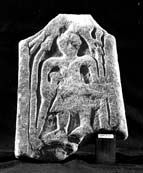
Object type: Incomplete shaft, possibly complete grave-marker [1]
Measurements: H. 27.2 cm (10.7 in); W. 20.4 > 17.8 cm (8 > 7 in); D. 6.5 cm (2.5 in)
Stone type: Sandstone, dirty, reddish brown colour, medium to coarse, quartz and feldspar grains evident, slightly micaceous. Upper Carboniferous, Millstone Grit Group. [G.L.]
Plate numbers in printed volume: Ills. 591-6, 608
Corpus volume reference: Vol 8 p. 223
(There may be more views or larger images available for this item. Click on the thumbnail image to view.)
This is part of a very small and thin monument, perhaps in its final form a slab rather than a shaft. The edges are rounded.
A (broad): Almost filling this face is a frontal figure in a short tunic. He has a round almost featureless head (although faint traces of eyes and nose remain), shoulders rounding in a boneless curve into his upper arms, and pointed feet both facing left. In his right hand he holds a sword with a distinctive pommel. His left hand is worn but appears to grasp another weapon with a pointed end curved in front of his body. He is framed on either side by the staffs of other weapons — clearly a spear on his right, although its head curves towards the top of the figure's head. There may be a straighter spear on his left, but its head is not clear. This may instead be a chair on which the figure is meant to be seen as seated, as suggested in Collingwood's drawing (1915a, 228, fig. u). The fringed elements on either side above can be interpreted as the foot (on the right) and part of the tail of a creature— a dragon according to Collingwood, or a bird.
B (narrow): Three volutes of a simple scroll, clumsy but still organised into alternate facing volutes, with a terminal at the top which bends back on itself and throws off two simple buds at each upper corner. The volutes end in tri-lobed forms, variously fruit and leaf-like, and there are small pointed buds in two of the spandrels.
C (broad): Dressed smooth
D (narrow): An irregular interlace ending in what could be a narrow Stafford Knot (simple pattern E) at the top. It is very shallow with a smoothly rounded narrow strand.
In its style and layout and lack of clear crossings, the interlace on face D is very reminiscent of that on one face of the arm fragment Otley 11 (Ill. 603). This was probably a very slim monument, which may have been cut down to further its use as a grave stone. The sides certainly do not appear to represent the full width of the original designs, and the scroll on face B is either actually earlier than the carving on the front or a very fair stab at an earlier pattern — in which case why is it not at its full width? The pattern on face D has crossings very reminiscent of the scroll on face B of the head fragment Otley 7 (Ill. 598). Is this what would be left if part of such a head was pared down? This piece is actually the same stone as Otley 7, part of the head of a much earlier cross.
The figure carving has a close companion in the piece from Weston, across the river Wharfe from Otley (p. 268, Ills. 777, 781), and appears like it to be a memorial to an individual, reflecting the 'martial ideal' of the patrons, either Scandinavians or with a Scandinavian-influenced taste, rather than a Christian theme (see Chap. VII, p. 75). That stone also appears to have been cut down from an earlier sculpture, probably a cross-head.
