Select a site alphabetically from the choices shown in the box below. Alternatively, browse sculptural examples using the Forward/Back buttons.
Chapters for this volume, along with copies of original in-text images, are available here.


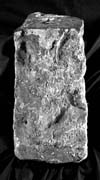
Object type: Centre of cross-head
Measurements: H. 42.5 cm (16.7 in); W. 21.3 cm (8.4 in); D. 24.5 cm (9.6 in)
Stone type: Sandstone, pale brown-grey, quartzose, moderately well sorted, very fine to fine grained, slightly micaceous. Pennine Coal Measures Group. This fragment appears quite different petrologically from three of the other sandstone cross fragments (Little Ouseburn (Holy Trinity) 2, 3 and 4) described by J.S. which are all coarser grained, quartzose Millstone Grit type lithologies. However, it does appear to be very similar to no. 1 and to be from a similar Pennine Coal Measures Group sandstone source. [G.L.]
Plate numbers in printed volume: Ills. 530-5; Fig. 13d
Corpus volume reference: Vol 8 p. 209-11
(There may be more views or larger images available for this item. Click on the thumbnail image to view.)
The fragment represents the centre of a large cross-head, certainly of a type which would have had curved armpits and expanded terminals, although exactly which type cannot be determined.
A (broad): The centre is encircled by a triple moulding, the inner of which is cabled, within which is a very damaged frontal figure. It has a dished halo, a pointed, possibly bearded, face with drilled eyes, and hair with curls over the forehead and long locks ending in an outward turning curl at either side. The figure probably has a long-sleeved robe with wide sleeves, draped so as to leave a wide V below the face (possibly with a trace of the neckline of an undergarment). Its right hand is raised in front of its body, possibly blessing, certainly touching the top of a square book: the left arm is unclear but there seem to be fingers of a hand holding the book from below.
B and D (narrow): Completely cut away.
C (broad): The centre is again circled with a fine triple moulding, rather battered: it is not certain whether the inner moulding is cabled on this face. Within this is an elegant bush-scroll, rising from a base, perhaps the top of an urn. Five double or indented stems rise from the base. The outer two end in a large flower. The next two are the stems which form the paired volutes on either side: these volutes terminate again in large open flowers. Between them is the main stem, which branches off into two further tendrils ending in round buds before terminating at the top in what is clearly an open, umbrella-like leaf-flower or 'Byzantine blossom'.
The figure on face A has been variously described as a figure holding a book satchel and therefore a precursor to a group of crosses with this theme found at York and in eastern Yorkshire, especially Nunburnhome (Pattison 1973, 229; Lang 1991, ill. 710); as a female figure on the basis of its hair style (Lang 1993, 265); and as the half figure of an Evangelist (see below). The figure's hair shows curls organised into bands going back from the face and this can be a female style, but one of the Evangelists in the Book of Cerne, a Mercian prayer book of the ninth century, has the same hairstyle, including the outward turning wave at the end (Brown, M. 1996, pl. IIIa). Most recently, the figure has been said to be an Evangelist, and compared to the busts of Evangelists on the Otley 1 shaft (Garrison et al. 2001, 31, cat. 51). The Otley figures, however, are much more solid, classically inspired depictions, not frontal like the figure here, but with their heads turned alternately left and right (Ill. 564).
It would also be unusual, if not unprecedented, to have an Evangelist at the centre of a cross-head. I would suggest the figure is more likely to be that of Christ. Crosses with a figure encircled at the centre are actually quite rare among surviving sculptures. There are parallels in both Northumbria and Mercia: for example the cross-head from Hart in co. Durham which has been dated to the early ninth century. This has a depiction of the Agnus Dei, that is, Christ, on one face, and a scroll which expands into the arms on the other (Cramp 1984, pl. 82.417–18). The Rothbury head in Northumberland, also ninth century, has a Crucifixion filling one face, but the other face has a roundel at the centre, its original depiction now irrecoverable (ibid., pl. 211.1206–7). A lost cross-head from Hoddom, Dumfriesshire, appears to have had representations of Christ in roundels on both faces (Brown 1937, pl. CVII), and another had an encircled Agnus Dei at its centre (Collingwood 1927, fig. 51). Much closer is a cross-head from Easby, north Yorkshire (Lang 2001, ills. 193, 197). A heavier version of the type is found in Mercia, for example at Eyam in Derbyshire. The roundel at Eyam holds a depiction of the Virgin and Child (Routh 1937, pl. XIVb). There is also the evidence of the tenth-to eleventh-century Durham cross-heads, which represent a revival of earlier Anglian styles, and suggest that the overall form was much more widespread, especially in Bernicia but perhaps in Northumbria as a whole, than we can now see (Coatsworth 1978; Cramp 1984, pls. 43.205–47.20). The centres of these Durham cross-heads include depictions of the Crucifixion, the Agnus Dei, and the Baptism of Christ, which suggests a greater variety, but all centred on the figure of Christ.
The bush-scroll on the reverse face at Little Ouseburn is interesting, with its large open blossom terminal. The fineness of its cutting has been compared to Croft 1, north Yorkshire (Lang 2001, 89-92, ills. 147–52), and Minster 1 in York (id. 1991, ills. 1–5). It has strong relationships with eighth- to ninth-century metalwork: its fine indented strands compare with the bush-scrolls on the Ormside bowl, the Bischofshofen cross, and even more interestingly, with the scroll in the background of a manuscript miniature of St John in the Barberini Gospels, which with its fine double pen-lines and a great open Byzantine blossom is exactly like the terminal of the scroll on the Little Ouseburn sculpture (Webster and Backhouse 1991, cat. nos. 133, 134 and 160; see Fig. 13f–i, p. 51). This manuscript has been ascribed to Mercia, but also sometimes to York, and though this has been dismissed (ibid., 205), the closeness in style requires some explanation. In the area (though just outside the West Riding), the closest parallel is with the Cundall/Aldborough shaft (Lang 2001, ills. 173–5, 182; see Chap. V, pp. 53–4). It is possible that this head, like Ilkley 2 (Ills. 357–60), is also the work of the 'Uredale master' (Chap. VII, p. 71).
It is also interesting that the stone type appears to be the same as that for the shaft represented by Little Ouseburn 1, and different from that for Little Ouseburn 2, 3 and 4, supporting the view that there are fragments of two different periods from this site. It is a pity that the edging of the head has not survived, so that the possibility of a relationship to one of these shafts can only be suggested.
