Select a site alphabetically from the choices shown in the box below. Alternatively, browse sculptural examples using the Forward/Back buttons.
Chapters for this volume, along with copies of original in-text images, are available here.


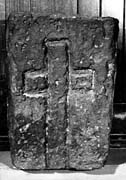
Object type: Grave-marker(?)
Measurements: H. 51.5 cm (20.3 in); W. 35 > 33 cm (13.7 > 13 in); D. 19.5 cm (7.7 in)
Stone type: Good quality, well sorted fine-grained micaceous sandstone with well-rounded grains. Body colour light yellow brown (10YR 6/4), but has been patchily burnt to a light brown colour on some surfaces (7.5YR 6/4). Possibly the Lower Plompton Grit, Namurian, Upper Carboniferous of local origin. [J.S.]
Plate numbers in printed volume: Ill. 800
Corpus volume reference: Vol 8 p. 274
(There may be more views or larger images available for this item. Click on the thumbnail image to view.)
The approximately rectangular slab is carved on only one face.
A (broad): A separately outlined upright and two side arms form a plain Latin cross (type A1) which dominates but does not fill the face. The outline is deeply gouged rather than incised so that the cross itself seems to stand out. The edges of the side arms are 'bevelled' away from the centre. At the centre of the crossing is a small gouged depression: it is difficult to see what this was for but it may have been to do with measuring-out rather than to provide a setting.
Appendix A item (Stones dating from Saxo-Norman overlap period or of uncertain date)
While it is impossible to date with certainty such a plain piece, which has no diagnostic features, similar plain slabs are found on sites with undoubtedly pre-Conquest sculpture, as at Lythe in northern Yorkshire (Lang 2001, ills. 1152–3).
