Select a site alphabetically from the choices shown in the box below. Alternatively, browse sculptural examples using the Forward/Back buttons.
Chapters for this volume, along with copies of original in-text images, are available here.


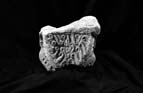
Object type: Spout / recut respond
Measurements: H. 23 cm (9 in); W. 33 < 37 cm (13 < 14.5 in); D. 20 < 23 cm (8 < 9 in)
Stone type: Pinkish grey (5YR 8/1) medium, to coarsegrained, poorly sorted, clast supported, bioclastic limestone. Clasts vary from 0.5 to 2.0 mm, but are mostly in the range 0.7 to 1.5 mm, with a few up to 5 mm. Clasts vary from sub-angular to rounded, with the rounded clasts resembling ooliths. Doulting stone, Upper Inferior Oolite Formation, Inferior Oolite Group, Middle Jurassic
Plate numbers in printed volume: Pls. 361-5
Corpus volume reference: Vol 7 p. 184
(There may be more views or larger images available for this item. Click on the thumbnail image to view.)
It is difficult to describe this piece in any conventional terms, either in form or ornament. It has certainly been used as a water spout and the hole for the spout look secondary. The labelling of the faces is for descriptive purposes only.
A: One face is concave and shield-shaped, and on either edge are rows of inward facing 'pot-hooks', one of which on each side is extended into the middle. The central section has a jumble of similar features.
B: The upper part is plain and uncarved but cut into its surface are a row of similar 'pot-hooks' of unequal length, at the base four pellets and a rounded 'arm'.
C: Cut away
D: A blank uncarved area into which a row of seven neatly graduated 'pot-hooks' are cut, and at the base a row of pellets and a bent 'arm'.
E: Roughly dressed, with a hole cut through
F: The hole emerges at an angle between the two 'arms'.
Appendix A item (stones dating from Saxo-Norman overlap period or of uncertain date).
Originally this seems to have been considered as a decorated water spout of medieval date, which was held in two clasping arms (the pellets presumably seen as buttons). Tudor- Craig, who was the first to consider the piece in detail and to publish it, saw the faces underneath the spout (A, B, D) as evidence that the object was originally a respond or capital, and of pre-Conquest date (Tudor-Craig 1990, 215, 218). Her idea that this was 'a Corinthian capital designed from first principles' (ibid., 218) is ingenious, and certainly the hole and the base (F) are very roughly cut. On the other hand it is difficult to see the 'pot-hook' decoration as primary to the 'arms' since they fit so neatly around them, and the row of pellets is either respected by the line of hooks or contemporary with them. If anything the 'pot-hook' decoration could have been secondary. It is not impossible to see this as an experimental capital, and disordered hooks and links can be found on some late cross-shafts in northern England (see Bailey and Cramp 1988, ills. 551–4), but this remains an isolated example, and of doubtful date.
