Select a site alphabetically from the choices shown in the box below. Alternatively, browse sculptural examples using the Forward/Back buttons.
Chapters for this volume, along with copies of original in-text images, are available here.


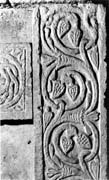
Object type: Jambs of arched opening to the north porticus of church
Measurements:
North porticus
H. of opening 239 cm (94 in)
W. of opening 173 cm (68 in)
D. max. of opening 74 cm (29 in)
East jambs, south pilaster
H. 142 cm (56 in); W. 24 > 23.5 cm (9.5 > 9.25 in)
East jambs, north pilaster
H. 142 cm (56 in); W. 23.5 cm (9.25 in)
Lower inset panel with triangular interlace
H. 24 cm (9.5 in); W. 25 cm (9.75 in)
Upper inset panel with circular plant-scroll
H. 25.5 cm (10 in); W. 25.5 cm (10 in)
Projecting depth for wall base
10.2 cm (4 in); top 7.6 cm (3 in)
Width of whole opening
73 cm (28.75 in)
West jambs, north and south pilasters
H. 142 cm (56 in); W. 25 cm (9.5 in)
Panel of interlace
H. 23 cm (9 in); W. 24.2 cm (9.5 in)
Plain panel
H. 23 cm (9 in); W. 24.2 cm (9.5 in)
Projection of strip surround on north face
0.6 cm (0.25 in)
Stones in arch soffit
c. 23.5 cm (9.25 in) square
Stone type:
1a. (East jamb of arch on north side of nave: see Ill. 410.) All the stonework is of the same type, a pale grey (10YR 8/1–2) oolitic limestone consisting of closely-set evenly-sized ooliths of 0.3 to 0.4mm diameter, in contact and projecting in 'millet-seed' fashion on the stone surface, with no obvious calcite matrix. A bivalve is seen in cross-section near the top of the northern pilaster. 'Upper Building Stones' oolite of Chilmark Member, Portland Stone Formation, Portland Group of Vale of Wardour, Upper Jurassic
1b. (West jamb of arch on north side of nave.) Oolite as no. 1a, in parts slightly coarser-grained, with ooliths of 0.4 to 0.5mm diameter. 'Upper Building Stones' oolite, Vale of Wardour
1c. (Head of arch on north side of nave.) Nine of the stone slabs, including a corbel in the centre row resting on the impost on the west side of the arch, are of 'Upper Building Stones' oolite as in nos. 1a and 1b. The remaining nineteen, one of them being the corbel on the impost on the east side of the arch, are of yellowish grey oolitic limestone with a crystalline calcite matrix pitted by vacated oolith sockets of 0.5 to 0.6mm diameter, and with much shell debris in thin 2mm to 3mm fragments, some slabs showing calcite veinlets. All these features are characteristic of Bath stone, Chalfield Oolite Formation.
1d. (Jambs of arch on south side of nave: see Ill. 424.) All the stonework of the jambs is a pale grey oolitic limestone of 'millet-seed' type. The vertical slabs on the inner face of each jamb show scattered cavities of 1 to 2 cm diameter, some of them recognisable as hollow casts of gastropods and 'Trigonia' as in the roach facies of Portland stone. 'Upper Building Stones' oolite, Vale of Wardour
1e. (Head of arch on south side of nave.) Pale grey oolitic limestone of 'millet-seed' type. 'Upper Building Stones' oolite
Plate numbers in printed volume: Pls. 410-23
Corpus volume reference: Vol 7 p. 206-8
(There may be more views or larger images available for this item. Click on the thumbnail image to view.)
The arch into the north porticus (Ill. 410) is formed from a triple band of stone blocks, and springs from a hollow chamfered impost on the east and a plain chamfered impost on the west. The central band of the soffit of the arch is decorated by a series of alternate raised stone slabs, outlined with Roman bricks and separated by sunken panels of bricks which are now blank and plastered. Some of the bricks outlining the stones form three crosses. The centre four slabs plus two bricks on the south face could have been renewed. The lowest voussoirs are separated by a single corbel.
East face
Below the impost the jambs of the arch are composed of three bays, each about 23 cm wide. The north and south bays are pilasters formed from single stones, 9 cm thick and decorated with plant-scrolls, which finish at the base with an incised line and a plain panel with a triple incised projecting plinth (Ills. 411–12). The two pilasters are separated by alternate sunken panels and flush slabs in the manner of the arch; the two upper are decorated, but at the base instead of a slab is a projecting block rather like an inverted corbel. All are supported on a projecting chamfered plinth. The chamfered plinth on each side is part of the same stone as the jamb.
Although based on the same formula and in the same style, there are variations between the plant-scrolls on the two pilasters. On the north pilaster there are six alternate facing volutes, springing at base from a single twisted strand which curves out to form the first trumpet-shaped node (Ill. 419). The lowest scroll contains a rather jumbled group of two small pointed and cross-hatched leaves, and plain oval rounded leaves of palmette type which cling to the interior of the stem. The five volutes above however maintain the same formula: the trumpet-shaped nodes have sunken centres and serrated cups, from which spring a central bud, outlined and centrally divided, and a pair of alternate facing volutes which contain palmette leaves, a large enclosed berry bunch of triangular type, and a stem which terminates in an enclosed triangular leaf which hooks up and round to fill the spaces between the volutes (Ill. 417). The scroll finishes at the top with a pair of leaves sprouting upward but their tips have been broken off.
The scroll on the south pilaster springs from a single stem which neatly fills the base and arches up and through the first volute. The trumpet-shaped nodes are ridged and with serrated cups from which sprout a pair of rounded buds with scooped centres and alternate facing volutes which enclose palmette leaves and a globular feature from which hang a pair of pointed enclosed berry bunches (Ill. 420). From each node springs a small pointed and enclosed leaf which hooks up and over the volute above and fills the spaces between the strands, in a more naturalistic way than on the north pilaster (Ill. 418). The scroll terminates in two leaves which sprout upwards, but their details are worn off and the tips are broken.
In the centre the lower panel frames a triangular knot pattern in which each knot is linked by two strands to the adjacent triangle (Ill. 416; Allen 1903, 298, no. 738). The upper panel frames a floral design in which the centrepiece is a quatrefoil of small rounded petals in the shape of a cross (Ill. 415). This is surrounded by a single circlet, a two-strand twist and an outer circlet. Each corner of the frame is filled by a triangular composition of scooped and rounded leaves.
West face
The western jambs are constructed in the same fashion as the eastern, but the north and south pilasters are uncarved save for their plinths where the fine cutting of the incised mouldings is still crisp. Between these two uprights there is, at the base, a similar inverted corbel as on the east, and one carved and one plain panel with sunken areas in between (Ills. 421, 423). The carved panel frames triangular interlace with median-incised strands forming triangular knots repeated in four corners of the square (Ill. 422; Allen 1903, 287, no. 731). The carving is remarkably crisp, and in fact all of this face of the opening is much less worn than the east.
This very elaborately decorated opening has all the appearance of coherent and careful planning, in which the alternation of recessed and raised surfaces could have provided a play of light and shade and colour. If one compares the opening into the southern porticus (Ill. 424), one is immediately struck by the contrast: there is the same formula — the arch head is formed from red tiles with wide mortar joints, and there are three stone slabs set in the soffit of the arch — but the alternation of stone blocks and red tiles which form cruciform shapes is absent, the imposts are rectangular slabs not hollowed or chamfered, and the three uprights which form the jambs are morticed into them. This is a workmanlike structure which could have been enhanced by paint, and I do not think that one need see it as earlier and more experimental than that of the northern porticus, as did Talbot (1877a, 216–17), but rather of a lower hierarchy of importance. Moreover the fact that the east jamb of the north porticus is more elaborately carved than the west may be similarly significant (see Ills. 412, 421). Alternatively, since all of the decorative elements are independent units forming a casing for the soffit of the arch rather than being mortised into the imposts as on the south side, this may indicate that they have been carved elsewhere and were all that was available. This seems less likely, but there are strange features which no-one has been able to explain (Taylor and Taylor 1965, I, 107), such as the pairs of apparently non-functioning brackets or corbels on each face (Ills. 411, 423). The upper brackets could have supported something standing in the void above or could have been a painstaking copy of a model in which elements were misunderstood, but the curve of the arch behind the corbels makes it virtually impossible for anything to stand on them: perhaps they are decorative, like the projecting bases.
The likeness of some of the details to southern English manuscripts and in particular the Vespasian Psalter (BL Cotton MS Vespasian A.I, fol. 30v; see Ill. 527) has been often noted: Kendrick compared the palmette-type leaves in the interior of the scrolls to this manuscript and also the Reculver cross (1938, 181), and I have also compared the triangular plaits, the thin edging and superimposed panels found on the Vespasian Psalter arch with the construction at Britford (Cramp 1972, 83). But one should not forget that the Vespasian Psalter has been seen as an eclectic work of art, and the Britford sculptures seem to be the same, exhibiting the taste for minor variation of detail which is so characteristic of the Anglo-Saxon aesthetic. Indeed, as early as the depiction of St Luke in the Augustine Gosels (Webster and Backhouse 1991, ill. 1), an inspiration could be seen for the elaborate bases and plinths on which the pilasters stood.
The palmette or acanthus-like internal leaves are widely dispersed on sculptures and manuscripts of the late eighth to early ninth century (see Cramp 1972, 141–3, Abb. 1; Gem 1991a, 187). Nevertheless the vinescrolls with the enclosing rings around the bunches, and the small pointed or rounded leaves also ringed round and divided, must have been, as Kendrick was the first person to declare, influenced by some knowledge of Italian sculpture. Such scrolls in the Italo-Byzantine style are found in the closure screens from Santa Sabina in Rome dated AD 824–827, and in other pilasters or altar frontals dated to the ninth century (Ermini 1972, pls. XI and XX), whilst palmettetype leaves which ring the interior of vinescroll volutes are often found, for example at Brescia where they are dated eighth to ninth century (Panazza and Tagliaferri 1966, pls. XL–XLIII). So both the idea of decorated pilasters and the details of the leaf and berry bunches can be found in Italy c. AD 800 (Cramp 1999, 37–8). But there is something in the treatment of the motifs at Britford, in particular the scroll organisation with the hooked leaves and the internal variation in the scrolls, which is peculiarly English. The palmettes, which in Italian carvings are dated to the late eighth/early ninth century (Serra 1974, pls. LXXXII–V), can be paralleled also at Codford St Peter (p. 211, Ill. 428), whilst the interlace pattern occurs in English and Irish manuscripts. The Continental parallels then can be seen as translated into an English idiom. Kendrick suggested, with no supporting evidence, that this work could be assigned to the reign of Ecgberht, and I have endorsed that, citing in support his exile at the Carolingian court before his accession in 802, his long reign until 839, and his continued contact with the Continent (Cramp 1999, 40). A date therefore around 800 seems reasonable for what may well have been a royal foundation, with the northern porticus especially embellished either as a relic chamber or to house an important tomb.
