Select a site alphabetically from the choices shown in the box below. Alternatively, browse sculptural examples using the Forward/Back buttons.
Chapters for this volume, along with copies of original in-text images, are available here.


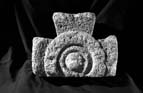
Object type: Cross-head
Measurements: H. 22 cm (8.75 in); W. 30 cm (11.75 in); D. 12.5 cm (5 in); Diam. of roundel 20.5 cm (8 in)
Stone type: [Granite?]
Plate numbers in printed volume: Pls. 374-8
Corpus volume reference: Vol 7 p. 188
(There may be more views or larger images available for this item. Click on the thumbnail image to view.)
The central roundel forms the major part of the head. The wedge-shaped arms are short, about 7.5 to 9 cm in length, and the armpits V-shaped (type B6).
A (broad): There is a deep central boss surrounded by a heavy roll moulding.
B and D (narrow): Plain
C (broad): There is evidence for a wide roll moulding, as on face A, but the central part of the head has been chiselled away.
Appendix A item (stones dating from Saxo-Norman overlap period or of uncertain date).
Crosses such as this, with a wide circular centre and short arms with V-shaped armpits, are generally considered to be late pre- or post-Conquest. For example such heads occur on the grave-markers from Whitby (Lang 2001, nos. 57 and 58, ills. 1168–71, 1176–9), and in Wessex on lastonbury Tor 1 (Ills. 255–7) and Winchester 92 from the Old Minster excavations (Tweddle et al. 1995, 337, ills. 691–4). In this last, which has been dated as mid to late eleventh century, the central ring and boss are flatter than Widcombe and there is an outer ring, but the arms are free, as are those on the ringhead from Glastonbury Tor. Most frequently, however, such cross shapes occur on disc heads or are incised on slabs as at Chollerton or Woodhorn, Northumberland (Cramp 1984, ills. 1335–6, 1404–5). As here, these late cross-heads are without edge mouldings. The distinction of the Widcombe piece is that it is free armed and not a ring-head, but the Winchester headstone provides the closest parallel although it is considerably larger than Widcombe.
The scale makes it unlikely that this was the head of a free-standing cross, although it has been related to the monument known as 'Gregory's Cross' which is recorded in the early eighteenth century as standing on the summit of Combe Down on the border of the parish of Lyncombe and Widcombe (I am indebted to Allan Keevil for this information and references). By the end of the eighteenth century this cross had obviously gone, since the Rev. J. Collinson noted that `there was formerly in this parish an old Cross dedicated to St Gregory' (1791, I, 174). The scale of this piece is more suitable for a grave-marker or gable cross, and in relation to the last suggestion the architect C. E. Davis recorded that in his restorations of St Thomas ? Becket's church in 1862 numerous fragments were found, the earliest being 'a Norman gable cross' which he said was closely similar to the gable cross from Bathampton (Davis 1864, 44–5). This description could fit the piece here, were it not for the entry in the Bath Weekly Chronicle, 21 March 1936, 'Notes and Queries', no. 423, from Mrs K. E. Symons who describes (see Evidence for Discovery above) the removal of two ancient cross fragments into the church, one a Norman gable cross and the other Saxon. In an accompanying drawing, however, the cross under discussion here is clearly depicted as Fig. 1, and another type A1 cross with a plate back (now lost) as Figs. 2 and 3, whilst the Bathampton gable cross depicted in Fig. 4 is exactly the same type as the Widcombe piece save for the centre of the head. It is possible then that this piece under discussion here is a gable cross, and that MrsSymons' second-hand account from Mr Edgar Wood is less accurate than that of the nineteenth-century architect, C. E. Davis. In which case our Saxon cross is the 'Norman' gable. This uncertainty is also reflected in the possible date, but the period mid to late eleventh century seems the most plausible.
