Select a site alphabetically from the choices shown in the box below. Alternatively, browse sculptural examples using the Forward/Back buttons.
Chapters for this volume, along with copies of original in-text images, are available here.


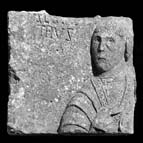
Object type: Panel with inscription
Measurements: H. 42 cm (16.5 in); W. 46 cm (18 in); D. 8 cm (3.25 in)
Stone type: Oolitic Limestone'
Plate numbers in printed volume: Pls. 379-80
Corpus volume reference: Vol 7 p. 189-90
(There may be more views or larger images available for this item. Click on the thumbnail image to view.)
Part of a broad flat-band moulding survives on the left, enclosing part of an inscription in capitals at the top left, and the upper part of a deeply carved figure on the right.
The figure is half turned to the right and is looking upwards. His right hand is held across his chest with two fingers raised in blessing. His other arm is missing, but he appears to be holding a book, part of which is visible at the lower right-hand corner. He is beardless and tonsured and his hair is represented by sharp incisions and ridges. His features are sensitively conveyed, the eyes delicately lidded with deeply carved pupils, the nose well shaped, and the mouth is downturned. His drapery is detailed and distinctive: the necklines of both the under and outer garments are edged with embroidered bands which are conveyed by deeply drilled circles, and the neckline of the outer garment finishes in a deep V. The folds of this garment around his arm and shoulder are formal and plate-like.
Inscription[1]The two lines of the inscription are set between the raised border on the left of the slab and the top of the head of the figure. The upper parts of the letters in the top line were lost with the upper section of the panel. What remains may be transcribed as follows:
[SCSPE]
TRVS
The reading is clear: S(AN)C(TV)S PETRVS ('St Peter'). The word sanctus is abbreviated with the usual nomen sacrum contraction, which can be found throughout the Middle Ages. Although only the bottoms of the last three letters in the first line remain, their reconstruction is not in doubt.
The letters were boldly cut, apparently with a V-trench, and the terminals of letters splay out, in some cases into definite serifs. The setting out of the letters is freehand and uneven and clearly did not follow ruled guidelines. The few letter forms are not very distinctive. The T and V and also the E, to judge from the remaining horizontal at the base of the letter, conform to their 'Roman' capital forms. The R is a variant of the 'Roman' capital with the bow open at the bottom. The incomplete C must have been the rectangular letter, with two right-angles. The three examples of S are all of the reversed-Z variety.
Appendix A item (stones dating from Saxo-Norman overlap period or of uncertain date).
Inscription These forms are not closely datable and can be matched both in early and late pre-Conquest inscriptions (Okasha 1964–8, table 1a). What is most striking in the small sample of letters is the preference for angular forms: the C and the three Ss, as well as the use of the rectangular ('Roman') E in preference to the rounded or uncial form. Capitals mixing 'Roman' forms with angular C and S can be found, for example, in the early tenth century on the stole and maniple of St Cuthbert (Battiscombe 1956, pls. XXXIII–XXXIV). A taste for angular letter forms is also characteristic of the eleventh century. The inscriptions on the sundial at Kirkdale and on the font at Little Billing are examples from around the third quarter of the century (Okasha 1971, 87–8, 97–8, pls. 64 and 85; Serjeantson and Adkins 1906, 187–8; Lang 1991, 163–6, ills. 568–73). The fashion was not universal, as can be seen in the dedication inscription of AD1056 from Deerhurst (Okasha 1971, pl. 28; Higgitt 2004). The 'Dowlish Wake' inscription does not show the revived interest in rounded forms or the taste for varying forms found in many inscriptions in Romanesque styles of the twelfth century. The lettering would be possible at any time in the tenth or eleventh centuries, and dates somewhat earlier or later cannot be excluded.
It is possible that further text has been lost from above what remains. However, Sanctus Petrus makes good sense on its own as the identification of the figure below and to the right. Most Anglo-Saxon and Romanesque figure sculpture appeared without identifying inscriptions but perhaps, as suggested below, this St Peter was depicted without his usual attribute of the key. Here the inscription is placed in the pictorial field, as on the Cuthbert vestments, the Ispwich St Michael or the perhaps twelfthcentury Virgin and Child from York Minster (Battiscombe 1956, pls. XXXIII–XXXIV; Okasha 1971, pls. 58, 149; Zarnecki et al. 1984, 164–5, 188), rather than on a framing moulding as at, for example, Inglesham (Ills. 453–4).
In a lengthy discussion of the iconography of St Peter in Anglo-Saxon art, John Higgitt has said, 'In Anglo-Saxon England St Peter, the prince of the apostles, was almost always represented as clean-shaven. Elsewhere he was almost always shown with a characteristic short, bushy beard' (1989, 267); and Higgitt further notes that 'The surviving examples of this Anglo-Saxon type are mostly of the tenth and eleventh centuries but it seems already to be fully formed as early as the end of the seventh century', since it is the image which appears on the coffin of St Cuthbert (ibid., 267–8). Although no incontrovertible source for this type of depiction of St Peter can be demonstrated, Higgitt suggests it could have been 'invented' in England. Further, 'The "Anglo-Saxon" type of Peter re-emerges vigorously in southern English manuscripts of the tenth and eleventh centuries, the earliest instance being in the Athelstan Psalter' (ibid., 282). Higgitt does however note that this type occurs after the Conquest, citing a twelfth-century carving from Wentworth, Cambridgeshire (ibid., 284, fig. 41).
In the catalogue for the Sotheby's sale (2004), in which this piece was lot 5, a wide range of parallels are suggested in passing, but the authors find their closest stylistic parallels in tenth-century manuscripts such as the Athelstan Psalter (Temple 1976, no. 5), although, as they say, the drapery is 'more regimented' and the treatment of the hair is different. Their final suggestion is that the most convincing parallel for Unknown Provenance 1 is to be found on the maniple amongst the Cuthbert embroideries, and in particular the depictions of Peter the Deacon and Pope Gregory (Battiscombe 1956, pl. XXXIV). It is true that the head type and stance on the embroideries are comparable (see Ill. 537), and the overgarment with its V-shaped neckline could well be a chasuble (although here, instead of stressing Peter's priestly role by holding a maniple, he holds a book and gives a blessing in his apostolic role).
It is difficult to compare the style of embroidery with that of sculpture, and ideally (as Elisabeth Okasha has stated in relation to the inscription: pers. comm.) one would like to provide a sculptural context. The Cuthbert embroideries dating to between 906 and 916 do provide a reasonable parallel, and there is a paucity of panel sculpture from the tenth/eleventh centuries in England although this was a period of great artistic renewal. In the south-west there is nothing surviving from the great religious houses such as Sherborne and Malmesbury, and only tantalising fragments from Muchelney (see p. 171) — a site which has been suggested as the origin of this unprovenanced piece. The chance discovery however of the outstanding sculptures from Congresbury (p. 149, Ills. 204–20), cautions one about conclusions based on such partial evidence for the carvings which must once have decorated the late Saxon churches.
My initial impression on seeing this piece was that it did not seem to belong to the same stylistic context which produced Congresbury, the Bristol Christ (Ill. 198), or indeed the Bradford and Winterbourne Steepleton angels (Ills. 404–6, 149–52), but that the facial details and the more regimented drapery folds placed it in a later context near to such sculptures as the Chichester reliefs (Zarnecki 1953b, pls. XXI, XXII). The treatment of the hair, the drapery folds, and details of the necklines, as well as the facial characteristics with their peculiar intensity of gaze can all be paralleled there, particularly in the Raising of Lazarus relief (ibid., pl. XXII), and one can note in particular the beardless figure behind Christ. The expressionism is perhaps more extreme on the Chichester reliefs than on Unknown Provenance 1, but I am not suggesting that the panels came from the same workshop, only that the Unknown Provenance 1 fragment could have been a part of the same fashion which produced narrative carvings such as the Winchester 'Sigurd' scene (Tweddle et al. 1995, ill. 646) and the Chichester reliefs. The Chichester reliefs have been variously dated between the early eleventh and mid-twelfth century, but I would incline towards Talbot Rice's dating of c. 1080 (Rice 1952, 110–12), and could see Unknown Provenance 1 as near to that in date, but whether before or after the Conquest is a matter for debate.
Since this is only a fragment of a panel of unknown scale, but is clearly the left-hand side of a composition, it is interesting to speculate why the figure is looking up with such intensity. Whatever his gaze was directed to must have been on another panel, and this could have been an ascending Christ, or Christ in Majesty, as shown in BL Cotton Galba A.XVIII, fol. 120v and fol. 21 (Temple 1976, no. 5, ills. 31, 33). In such scenes, as opposed to scenes of the Last Judgment, Peter would not have been distinguished by his key to the Kingdom. For that reason, since his key was from the seventh century onwards so much a distinguishing attribute, there may have been the need for an identifying inscription.
